

Introduction
The outbreak of open warfare between the United States, Israel, and Iran in late February 2026 marked one of the most dangerous escalations in modern Middle Eastern history. Coordinated strikes on February 28 targeted Iranian nuclear facilities, military infrastructure, and reportedly resulted in the assassination of Supreme Leader Ayatollah Ali Khamenei, triggering Iranian retaliatory missile and drone attacks across the Gulf and beyond. Amid this crisis, Pakistan sharing a long border with Iran, maintaining deep historical ties with Saudi Arabia, and preserving strategic relations with the United States faced immense pressure from multiple directions. Rather than succumbing to polarization, Islamabad executed a sophisticated diplomatic strategy that condemned aggression, offered mediation, moderated escalation, and protected allied interests without direct involvement.
Under the leadership of Prime Minister Shehbaz Sharif and Chief of Army Staff Field Marshal Asim Munir, Pakistan positioned itself as a voice of reason and restraint. By swiftly condemning the initial strikes, proposing to host US-Iran talks, invoking its Strategic Mutual Defence Agreement (SMDA) with Saudi Arabia to urge Iranian caution, and engaging all parties through backchannels, Pakistan prevented wider regional spillover while enhancing its geopolitical stature. This article demonstrates how Pakistan’s principled yet pragmatic approach not only safeguarded national security and economic stability but also established Islamabad as a key regional balancer an increasingly vital actor whose influence transcends traditional alliances.
Historical Foundations of Pakistan’s Balanced Middle East Policy
Pakistan’s foreign policy in the Middle East has long emphasized strategic autonomy, Islamic solidarity, and pragmatic engagement. Islamabad has maintained strong defense and economic partnerships with the United States, including counterterrorism cooperation and military assistance. Concurrently, cultural, religious, and geographic affinities bind Pakistan to Iran, despite occasional border frictions and sectarian nuances. Pakistan’s consistent non-recognition of Israel and vocal support for Palestinian rights align with broader Muslim-world consensus.
The relationship with Saudi Arabia forms the bedrock of Pakistan’s Gulf strategy. Decades of military training, advisory roles, and personnel deployments culminated in the landmark Strategic Mutual Defence Agreement signed on September 17, 2025, in Riyadh. This pact treats aggression against one signatory as aggression against both, providing Saudi Arabia with enhanced deterrence amid uncertainties in US commitments while securing Pakistan access to investments, energy supplies, and remittances. This alliance enabled Pakistan to act as a stabilizing bridge between Riyadh and Tehran during periods of tension.
These layered relationships equipped Pakistan uniquely for the 2026 crisis, allowing it to navigate competing demands with credibility and effectiveness.
Pre-War Mediation Efforts: Proactive Diplomacy in Action
In the lead-up to escalation, Pakistani diplomacy worked tirelessly to avert conflict. Foreign Minister Ishaq Dar publicly revealed efforts to position Islamabad as a mediator, offering Islamabad as a venue for US-Iran negotiations alongside other channels. During a March 2026 Senate briefing, Dar highlighted active engagements by Prime Minister Sharif and Field Marshal Munir at diplomatic and defense levels. Pakistan advocated Iran’s right to peaceful nuclear energy in meetings with US officials, including Secretary of State Marco Rubio, while maintaining constructive dialogue with Iranian counterparts.
These initiatives reflected Islamabad’s realistic assessment: military confrontation served no party’s long-term interests. By floating credible mediation proposals and keeping channels open, Pakistan demonstrated foresight and responsibility, laying the foundation for its influential role once hostilities commenced.
Crisis Response: Principled Condemnation Coupled with Restraint
Pakistan responded decisively yet measuredly to the February 28 strikes. Within minutes, Foreign Minister Dar condemned the US-Israeli actions as “unwarranted” and a violation of international law, calling for immediate de-escalation and resumption of diplomacy. Prime Minister Sharif contacted Iranian President Masoud Pezeshkian to express solidarity, while Pakistan’s UN mission echoed calls for restraint.
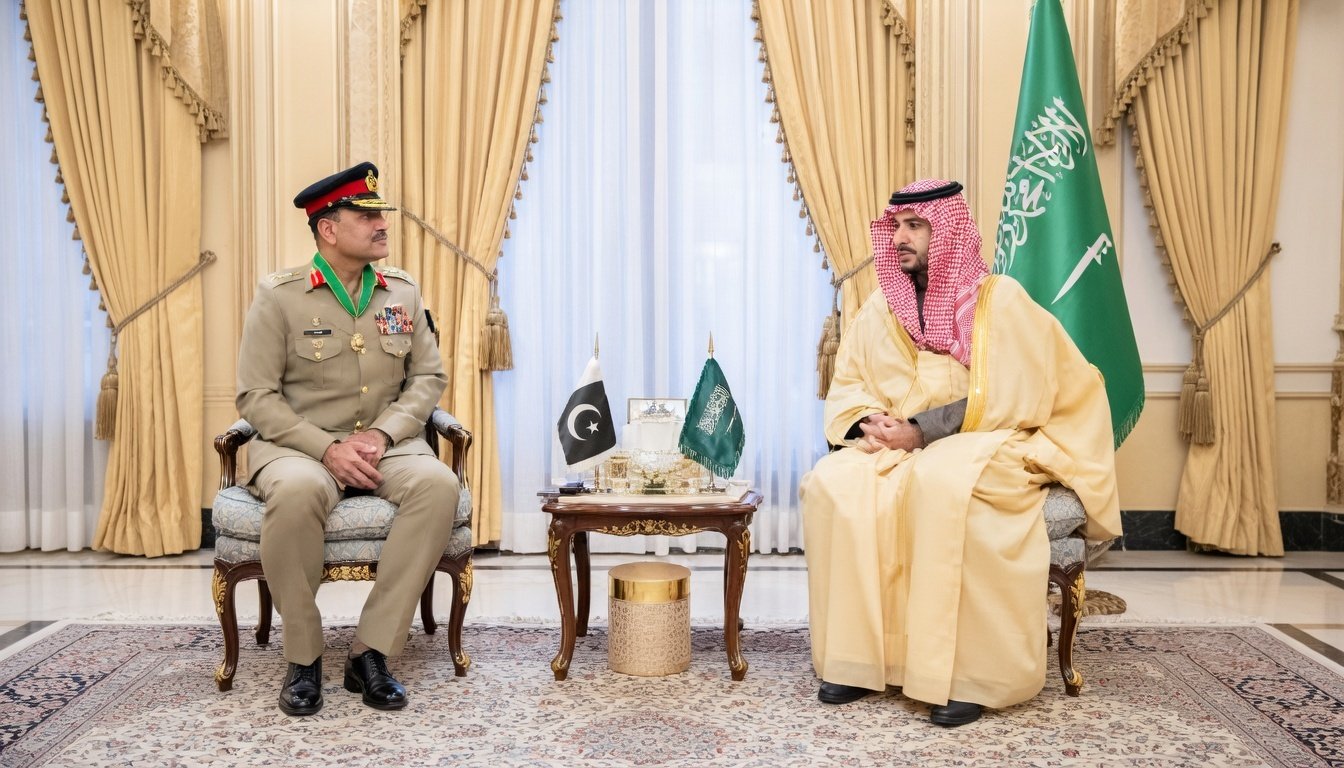
Critically, Pakistan leveraged the SMDA with Saudi Arabia to moderate Iranian responses. Dar directly conveyed to Iranian leadership that aggression against Saudi territory would invoke Pakistan’s treaty obligations, securing assurances that retaliatory strikes on Gulf states remained limited. Consultations between Field Marshal Munir and Saudi Defence Minister Prince Khalid bin Salman activated coordination mechanisms, reinforcing deterrence without troop commitments.
This dual approach vocal support for sovereignty principles alongside practical restraint shielded allies, limited escalation, and preserved Pakistan’s neutrality. Iran’s military leadership later acknowledged Pakistan’s “courageous stance,” underscoring Islamabad’s successful influence.
The Pivotal Role of the Pakistan-Saudi Arabia Strategic Partnership
The 2025 SMDA proved indispensable during the crisis. As Iran targeted Gulf infrastructure, Saudi invocation of the pact triggered high-level military consultations, signaling unified resolve. Pakistan’s invocation of treaty commitments deterred broader attacks on Saudi soil, protecting a vital economic lifeline while avoiding entanglement.
This partnership extends beyond defense to encompass energy security, trade corridors, and economic interdependence. By handling the SMDA with nuance honoring commitments to Riyadh without provoking Tehran Pakistan amplified its regional leverage. The alliance exemplifies mature statecraft, transforming potential vulnerabilities into strategic assets and reinforcing Pakistan’s position as a trusted stabilizer.
Conclusion
In the crucible of the 2026 US-Iran-Israel conflict, Pakistan demonstrated exceptional diplomatic maturity and strategic acumen. Through preemptive mediation offers, swift principled condemnations, effective backchannel moderation via the Saudi pact, and unwavering commitment to dialogue, Islamabad averted greater catastrophe while honoring alliances and protecting national interests.
Pakistan’s success highlights its emergence as a key balancer in an increasingly multipolar Middle East. No longer merely a peripheral player, Islamabad now commands respect as an indispensable actor capable of bridging divides others cannot. The Pakistan-Saudi partnership remains central to this influence, providing both deterrence and diplomatic weight. As the region seeks pathways to durable peace, Pakistan’s model of balanced, responsible engagement offers valuable lessons and affirms its rising prominence on the global stage.
- Al Jazeera. (2026, March 7). Caught between Iran and Saudi Arabia, can Pakistan stay neutral for long? https://www.aljazeera.com/news/2026/3/7/caught-between-iran-and-saudi-arabia-can-pakistan-stay-neutral-for-long
- Dawn. (2026, March). Pakistan offers to help with Iran-US talks. https://www.dawn.com/news/1978133
- The Diplomat. (2026, March). How the US-Iran War Has Upended Pakistan’s Diplomacy. https://thediplomat.com/2026/03/how-the-us-iran-war-has-upended-pakistans-diplomacy/
- Middle East Institute. (2025). Pakistan’s ability to thread the needle in relations with the US and Iran tested by the Israel-Iran war. https://mei.edu/publication/pakistans-ability-thread-needle-relations-us-and-iran-tested-israel-iran-war/
- Center for International Strategic Studies Pakistan. (2026, March). Policy Brief – March 2026 | US-Israel-Iran Conflict 2026. https://ciss.org.pk/policy-brief-march-2026-us-israel-iran-conflict-2026
Disclaimer: The views and opinions expressed in this article are solely those of the author and do not necessarily reflect the views, policies, or position of this website. The website does not endorse or oppose any opinion presented herein.
