

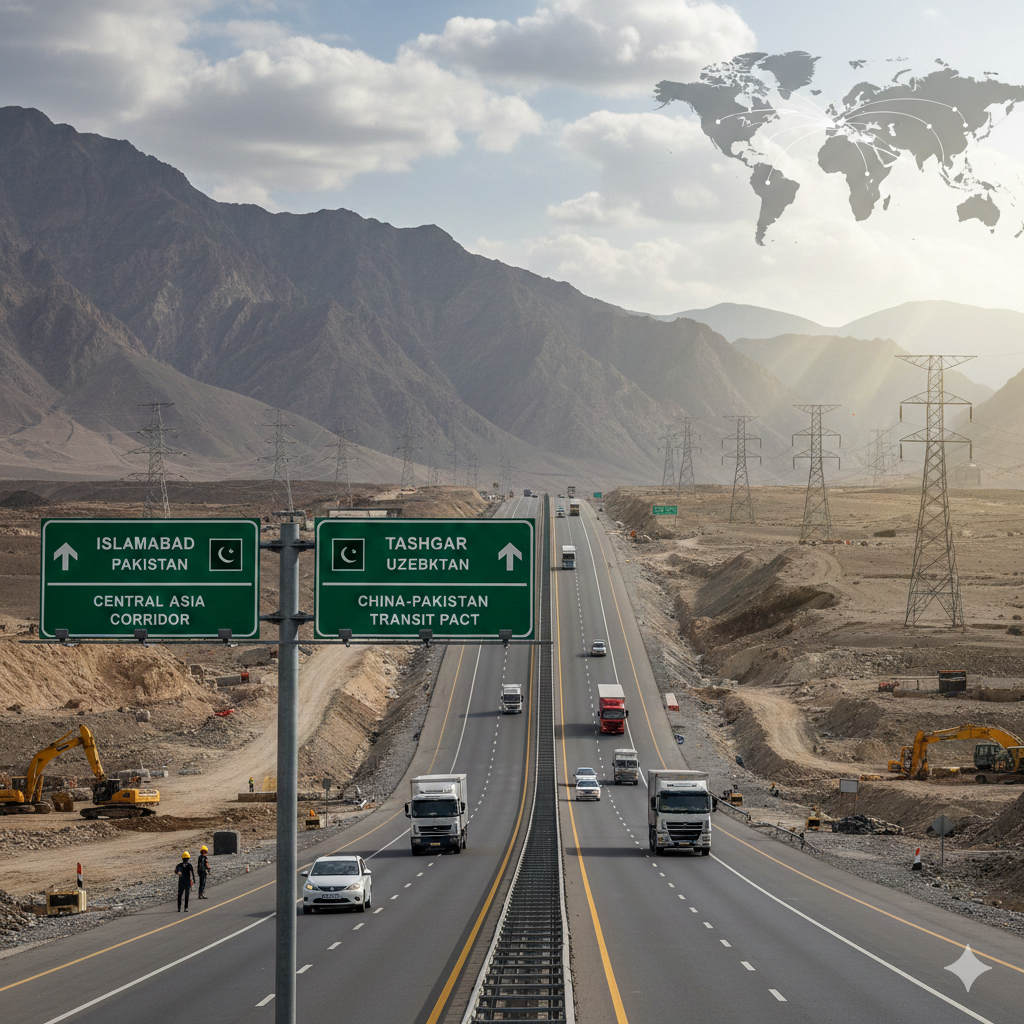
Pakistan has stepped up efforts to position its deep-sea ports at Gwadar and Karachi as key gateways for Central Asian trade, holding high-level consultations with China and advancing bilateral cooperation with Kazakhstan aimed at enhancing regional transport and transit links.
In Islamabad on Wednesday, Pakistani officials and Chinese representatives reviewed the Quadrilateral Traffic in Transit Agreement (QTTA), a transit-trade pact originally signed in 1995 by Pakistan, China, Kyrgyzstan and Kazakhstan that facilitates overland trade via China to Pakistan’s ports. Mohammad Sadiq, Pakistan’s Special Representative for Afghanistan, said the meeting focused on strengthening QTTA’s role in channeling cargo between Central Asia and Pakistan’s ports, noting that some transit traffic has been rising in recent months and that adjustments could make the route the region’s most efficient corridor.
The discussions coincided with a state visit by Kazakh President Kassym-Jomart Tokayev, highlighting renewed momentum for regional transport cooperation. Prime Minister Shehbaz Sharif said Pakistan and Kazakhstan agreed on the need to deepen economic ties, expand connectivity including through a Belarus–Russia–Kazakhstan–Uzbekistan–Afghanistan–Pakistan transport corridor, and set a target to increase bilateral trade to $1 billion within the next year.
In a related development, Prime Minister Shehbaz Sharif offered Pakistan’s deep-sea ports at Gwadar and Karachi as “vital trade outlets” for Central Asian states during the Pakistan–Kazakhstan Business Forum. He reaffirmed Islamabad’s commitment to expand rail and road links through Turkmenistan and Afghanistan and said state logistics entities are ready to facilitate cargo movement to international markets. Pakistan and Kazakhstan also agreed to form a joint working group to develop a five-year roadmap for trade, investment and connectivity.
Separately, Pakistan and Kazakhstan have agreed to work toward a formal framework aimed at boosting rail, road and multimodal connectivity to unlock an estimated $5 billion in potential trade and investment flows, with both sides emphasizing improved infrastructure as critical for linking Central Asia with South Asia, China, Africa and ASEAN markets via Pakistan’s ports.
The renewed focus on QTTA and multimodal corridors comes amid Islamabad’s broader strategy to diversify regional linkages and reduce reliance on unstable transit routes, particularly as connectivity through Afghanistan remains challenged by security concerns. The move also aligns with Pakistan’s long-term ambition to serve as a transit hub under frameworks such as the China–Pakistan Economic Corridor (CPEC).