

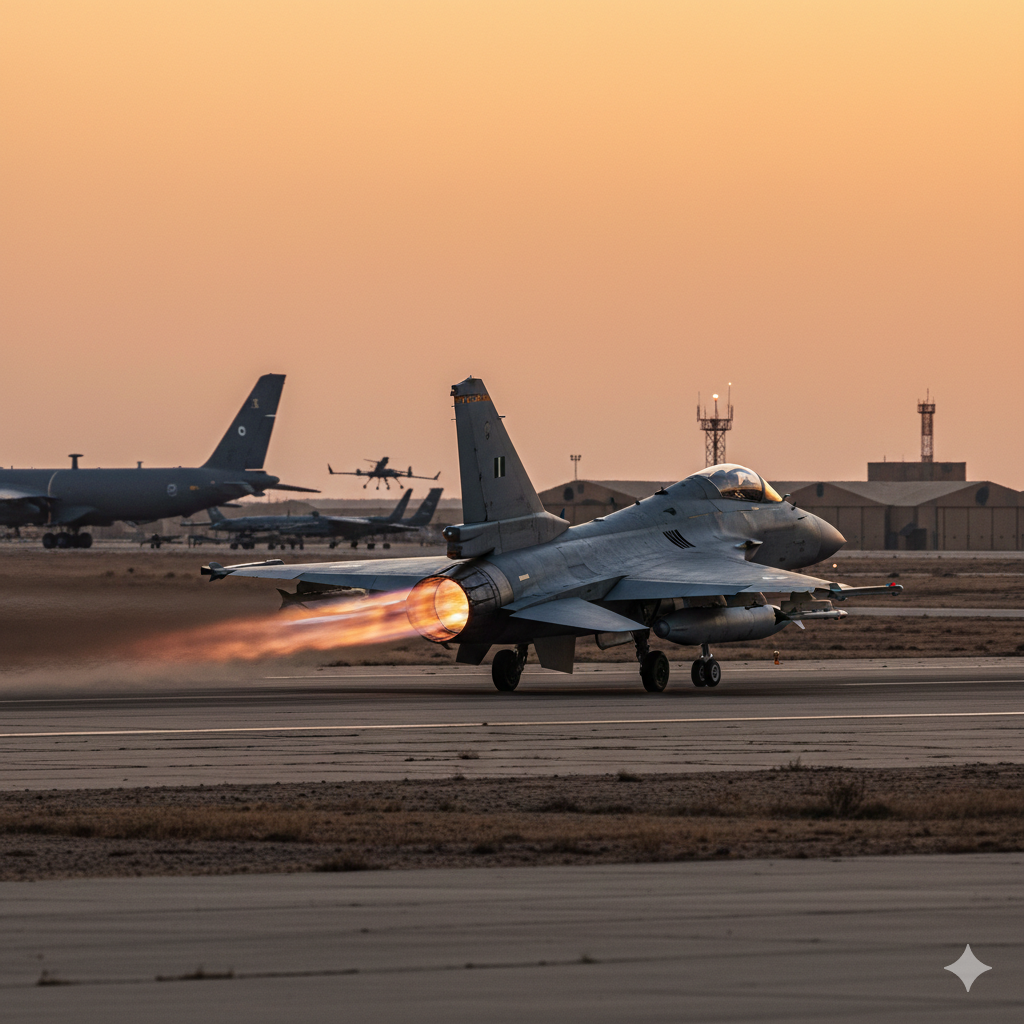
The Pakistan Air Force has conducted Exercise Golden Eagle within the operational jurisdiction of its Southern Air Command, the military’s media wing said on Tuesday.
According to a statement issued by the Inter-Services Public Relations, the exercise was designed to evaluate the force’s combat preparedness and operational flexibility through the coordinated deployment of its full range of air power capabilities.
The ISPR said the exercise followed a two-opposing-force framework and emphasised AI-supported, network-centric warfare concepts. It also incorporated locally developed smart and disruptive technologies, reflecting the changing nature of regional security challenges.
Operating under an integrated air defence architecture, participating forces combined conventional strike operations with cyber, space and electromagnetic spectrum activities to shape the operational environment.
During the kinetic phase, multi-role fighter aircraft operated under a “first-shoot, first-kill” doctrine, employing long-range beyond-visual-range missiles, extended stand-off weapons and precision-guided munitions. These missions were supported by airborne early warning and control systems and air-to-air refuelling platforms.
A notable aspect of the exercise was the employment of manned-unmanned teaming, with armed drones and loitering munitions executing deep-penetration missions in a contested and electronically degraded battlespace. The ISPR said this validated the PAF’s ability to sustain high-intensity operations in modern conflict scenarios.
The exercise was coordinated under a centralised command-and-control structure from the Next-Generation All-Domain Command and Control Centre at Air Headquarters Islamabad.
The military said the successful completion of Exercise Golden Eagle highlights the PAF’s continued focus on operational readiness, indigenous capability development and preparedness to address emerging and future security threats.