

At least 11 international flights have remained stranded at airports across Pakistan for the past three days as escalating conflict in the Middle East continues to disrupt regional and global aviation networks.
The crisis intensified after joint strikes by the United States and Israel targeted sites in Iran on Saturday. The attack reportedly resulted in the death of Iran’s Supreme Leader, Ayatollah Ali Khamenei, marking a dramatic escalation in regional tensions. US President Donald Trump vowed further action aimed at dismantling Tehran’s missile capabilities and preventing nuclear development.
Tehran responded with a large-scale missile barrage directed toward Gulf states and Israel, sharply intensifying hostilities and prompting widespread airspace closures across the Middle East.
The fallout has directly impacted flight operations in Pakistan. A foreign airline flight has been grounded at Multan Airport for three consecutive days, while two other internationally operated flights remain stranded at Sialkot International Airport due to regional uncertainty and rerouting complications.
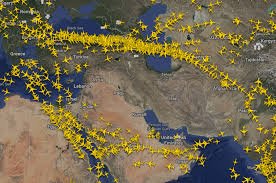
Meanwhile, overflight traffic through Pakistani and Afghan airspace has surged significantly as airlines divert routes to avoid restricted zones across the Middle East. According to data from Flightradar24, air corridors passing through Pakistan and Afghanistan have become some of the busiest in the world amid the crisis.
Global aviation disruption deepened as continued air strikes forced major regional hubs to suspend operations. Airports in Dubai, Abu Dhabi, and Doha, key transit centers linking Europe and Asia, were either closed or operating under severe restrictions. Dubai, widely regarded as the world’s busiest international transit hub, faced one of the most significant operational shutdowns in recent years.
With critical Gulf hubs offline, aircraft and crew have been left out of position, creating cascading delays across international airline networks. Carriers in Europe, Asia, and the Middle East have cancelled or rerouted flights, extending travel times and increasing fuel costs. The disruption has been compounded by the closure of Iranian and Iraqi airspace, routes that had gained strategic importance following the Russia-Ukraine conflict.
Aviation analysts warn that narrowing flight corridors are placing additional pressure on regional airspace. Ian Petchenik, communications director at Flightradar24, noted that intensified regional fighting and overlapping airspace restrictions are forcing airlines into limited routes, raising operational and safety concerns.
The situation remains fluid, with airlines monitoring developments closely as geopolitical tensions continue to reshape global air traffic patterns.