

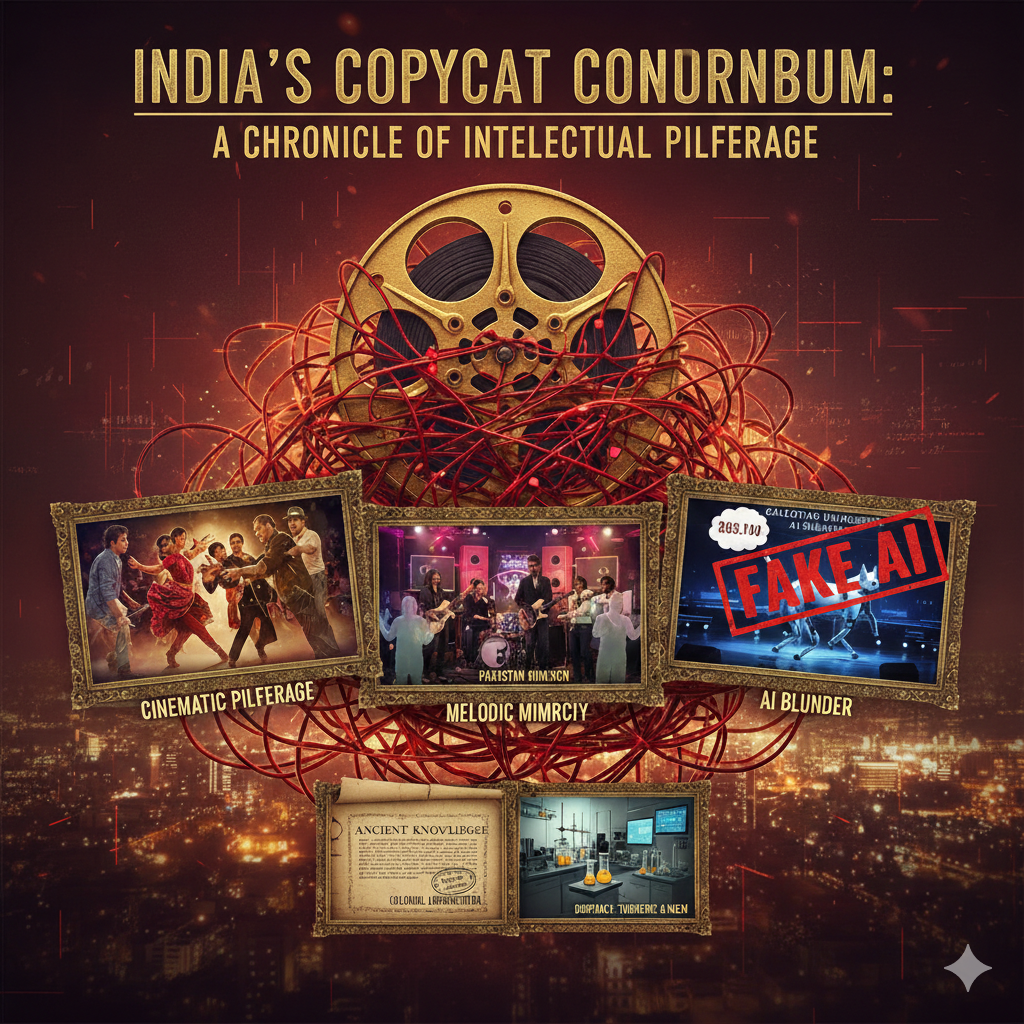
Introduction
In the bustling landscape of global innovation and creativity, India stands as a paradox a nation brimming with talent yet plagued by a persistent shadow of plagiarism and intellectual theft. The recent scandal at Galgotias University, where a Chinese-made robotic dog was paraded as an indigenous AI marvel, exemplifies this enduring issue. This incident, unfolding at the India AI Impact Summit in February 2026, not only sparked viral mockery but also ignited debates on India’s fraught relationship with originality. As one social media user quipped, “Galgotias didn’t invent the wheel they just claimed they did, after buying it from China!” This article delves into India’s tendency toward plagiarism, examining cinematic borrowings from Hollywood, musical appropriations from Pakistan, the Galgotias fiasco, and the historical underpinnings of such practices. Through a critical lens, we correlate these elements, highlighting how intellectual fraud undermines national progress, infused with historical analysis, expert quotes, and a dash of humor to underscore the absurdity. Ultimately, this exploration reveals a systemic “copy-paste” culture that demands urgent reform.
Bollywood’s Hollywood Heists: A Cinematic Plagiarism Pandemic
Bollywood, India’s glittering film industry, has long been accused of being a “remake factory,” churning out hits by liberally lifting plots, scenes, and even dialogues from Hollywood. This practice isn’t mere inspiration; it’s often outright replication, repackaged with song-and-dance sequences to suit Indian tastes. Take, for instance, the 2002 film Kaante, a shot-for-shot echo of Quentin Tarantino’s Reservoir Dogs (1992), where a heist gone wrong becomes a masala thriller complete with brooding anti-heroes. Similarly, Satte Pe Satta (1982) mirrors Seven Brides for Seven Brothers (1954), transforming a Western musical into a rustic Indian family drama. Other notorious examples include Murder (2004), cribbed from Unfaithful (2002), and Agneepath (1990), a desi version of Scarface (1983), where Al Pacino’s cocaine empire morphs into Amitabh Bachchan’s underworld saga.
Critics argue this reflects a deeper malaise. Film historian Ashish Rajadhyaksha notes, “Bollywood’s plagiarism is not just lazy filmmaking; it’s a symptom of risk aversion in an industry obsessed with box-office formulas.” Humorously, one might say Bollywood directors treat Hollywood scripts like a buffet pick what you like, add extra spice, and hope no one notices the original chef. Yet, this “inspiration” has economic repercussions: it stifles original storytelling, as evidenced by the success of rare originals like Andhadhun (2018), which ironically drew from a French short film but added unique twists. With over 50 documented cases of direct lifts, from Dhamaal (2007) aping It’s a Mad, Mad, Mad, Mad World (1963) to Partner (2007) cloning Hitch (2005), Bollywood’s habit perpetuates a cycle of intellectual fraud, eroding India’s creative credibility on the global stage.
Melodic Mimicry: Stealing Tunes from Across the Border
If Bollywood’s visual thefts are blatant, its musical appropriations from Pakistan are equally audacious, often crossing borders without credit or royalties. Pakistani music, rich in Sufi qawwalis and pop anthems, has been a fertile ground for Indian composers seeking “inspiration.” A prime example is “Munni Badnaam Hui” from Dabangg (2010), a direct rip-off of “Larka Badnam Hua Haseena Tere Liye” from the 1992 Pakistani film Mr. Charlie by Umer Sharif. Similarly, “Dil Dil Hindustan” from Yaadon ke Mausam (1990) echoes Vital Signs’ “Dil Dil Pakistan” (1987), turning a patriotic Pakistani hit into an Indian anthem ironic, given the geopolitical tensions.
The list is extensive: “The Disco Song” from Student of the Year (2012) lifts from Nazia Hassan’s “Disco Deewane” (1981), while “Mera Piya Ghar Aaya” from Yaraana (1995) borrows from Nusrat Fateh Ali Khan’s Sufi classic. Over 25 such instances have been cataloged, including “Agar Tum Mil Jao” from Zeher (2005) copying Tasawwur Khanum’s track. Pakistani artist Abrar-ul-Haq lamented, “It’s flattering until you realize they’re profiting off your work without acknowledgment.” Humor creeps in when considering the absurdity: Imagine a Bollywood hero serenading his love with a tune swiped from a rival nation’s pop star talk about musical espionage! This cross-border theft not only violates IP norms but fosters resentment, as seen in social media backlash where Pakistanis dub Bollywood “Copywood.” In an era of global streaming, such practices highlight India’s lax enforcement of music copyrights, costing original creators dearly.
The Galgotias AI Debacle: When ‘Innovation’ Meets Imitation
The February 2026 India AI Impact Summit was meant to showcase India’s tech prowess, but Galgotias University’s exhibit turned it into a farce. Professor Neha Singh proudly introduced “Orion,” a robotic dog purportedly developed at the university’s Centre of Excellence, touting its surveillance capabilities. Social media sleuths quickly identified it as the Unitree Go2, a commercially available Chinese model starting at $1,600. The backlash was swift: the university was ordered to dismantle its stall, with government sources citing misinformation. Galgotias denied claiming invention, blaming Singh for being “ill-informed,” and issued an apology emphasizing student learning with “globally available tools.”
This episode reeks of intellectual fraud, masquerading imported tech as homegrown innovation. As one X post humorously noted, “Galgotias: Where AI stands for ‘Artificial Indian’ faking it till you make it!” Critics, including the Centre, stressed that “misinformation can’t be encouraged,” underscoring the need for authenticity in AI showcases. The incident drew parallels to broader IP issues, with students admitting the robot was “bought a month back,” exposing a culture of shortcuts in academia.
Historical Roots of Intellectual Theft in India
India’s IP woes are not modern anomalies but echo a complex history. Ancient texts like the Vedas and Manusmriti hint at proto-IP concepts, valuing knowledge as divine property, yet without formal protections. Colonial Britain introduced laws like the Patents Act of 1856, but these favored imperial interests, allowing exploitation of Indian resources. Post-independence, weak enforcement persisted; the 1970 Patents Act prioritized affordability over innovation, fostering reverse engineering.
Biopiracy epitomizes this legacy: In the 1990s, U.S. patents on turmeric (for wound healing) and neem (as pesticide) were revoked after India proved these were traditional knowledge. The basmati rice patent by RiceTec in 1997 similarly sparked outrage, seen as theft of India’s geographical indications. Software IP thefts, like the 2002 SolidWorks case, highlight ongoing challenges. Economist Peter Yu observes, “India’s IP history reflects a tension between global norms and local needs, often tipping toward appropriation.”
Correlating with Galgotias, this episode mirrors biopiracy claiming foreign inventions as one’s own, perpetuating a colonial hangover of undervaluing originality. Humorously, it’s as if India’s IP timeline is a Bollywood sequel: same plot, new actors, endless remakes.
Criticizing the Culture of Copying: Fraud, Ethics, and Economic Impacts
India’s intellectual theft is not benign; it’s fraudulent, eroding trust and innovation. In entertainment, it stifles creators; in tech, it hampers R&D, with counterfeiting costing $11.9 billion annually. Ethically, it’s a betrayal as Vandana Shiva argues on biopiracy, “It’s piracy of the poor by the rich.” Humor aside (why invent when you can ‘Indianize’?), this culture fosters mediocrity, with global perceptions labeling India a “copycat nation.” Stronger enforcement, education, and incentives for originality are imperative to break the cycle.
Conclusion
From Bollywood’s Hollywood clones to Pakistani tune thefts and Galgotias’ AI sham, India’s plagiarism propensity reveals a historical and cultural entanglement with intellectual fraud. While humor lightens the critique envisioning a “Plagiarism Hall of Fame” in Mumbai—the stakes are high: economic losses, reputational damage, and stunted growth. To forge a truly innovative future, India must prioritize IP integrity, echoing Mahatma Gandhi’s words: “An ounce of practice is worth more than tons of preaching.” By fostering originality, India can transform from copycat to creator.
Bibliography and References
- IMDb. (n.d.). Bollywood movies that are copied from Hollywood or Japanese movies. Retrieved from
- ScoopWhoop. (2016, March 3). Here’s A List Of 50 Bollywood Movies That Took Some Serious Inspiration From Hollywood Movies. Retrieved from
- The Express Tribune. (2015, April 8). 10 songs Bollywood ripped off from Pakistan. Retrieved from
- Free Press Kashmir. (2023, April 6). 25 popular Bollywood songs that are actually copied from Pakistan. Retrieved from
- BBC News. (2026, February 19). Indian university faces backlash for claiming Chinese robodog as own at AI summit. Retrieved from
- AP News. (2026, February 19). A robotic dog made in China gets an Indian university kicked out of an AI summit. Retrieved from
- NDTV. (2026, February 19). “Misinformation Can’t Be Encouraged”: Centre On Galgotias Row. Retrieved from
- Kumar, D. R. (2019). United States Patents, Biopiracy, and Cultural Imperialism: The Theft of India’s Traditional Knowledge. Inquiries Journal. Retrieved from
- Mangal, S. (2005). Intellectual Property Rights: Indian Scenario. Journal of Business Administration Online. Retrieved from
- Bochańczyk-Kupka, D. (n.d.). A comparative analysis of intellectual property rights protection in China and India in the XXI century. Journal of International Studies. Retrieved from
