
Close Menu

    Subscribe to Updates

    Get the latest creative news from FooBar about art, design and business.

    What's Hot

    Germany Wholesale Prices Rise 1.2% in February 2026 Amid Ongoing Inflation Pressure

    March 13, 2026

    Pakistan Acts as Bridge-Builder Among Regional Capitals Amid Middle East Conflict

    March 13, 2026

    Iran’s New Supreme Leader Vows Revenge, Confirms Strait of Hormuz Will Remain Closed

    March 13, 2026
    Facebook X (Twitter) Instagram
    Trending
    • Germany Wholesale Prices Rise 1.2% in February 2026 Amid Ongoing Inflation Pressure
    • Pakistan Acts as Bridge-Builder Among Regional Capitals Amid Middle East Conflict
    • Iran’s New Supreme Leader Vows Revenge, Confirms Strait of Hormuz Will Remain Closed
    • PNSC Oil Vessels Reach Karachi Safely Under Pakistan Navy Escort Amid Maritime Security Concerns
    • US and Allies Clash with Russia, China at UN Over Iran Nuclear Program
    • Shehbaz Sharif Meets Saudi Crown Prince Mohammed bin Salman, Reaffirms Pakistan’s Support Amid Middle East Tensions”
    • Navigating the Information Fog in a Multipolar World
    • Pakistan’s Frontier Resolve: The Pakistan Army and Air Force’s Decisive Operations in Afghanistan and Recent Diplomatic Ascendancy
    Facebook X (Twitter) Instagram
    echoasianews.com
    • Home
      • Fact Check
      • War Updates
    • World News
    • Local News
    • Opinion
    • Business
    • Entertainment
    • Sports
    • Politics
    • Technology
    echoasianews.com
    Home»Opinion»The 18% Arbitrage: Why India’s New Trade Deal is a Lesson in Asymmetric Submission
    Opinion

    The 18% Arbitrage: Why India’s New Trade Deal is a Lesson in Asymmetric Submission

    Dr. Qasim Ali ShahBy Dr. Qasim Ali ShahFebruary 5, 20261 Comment4 Mins Read
    Facebook Twitter Pinterest LinkedIn WhatsApp Reddit Tumblr Email
    Share
    Facebook Twitter LinkedIn Pinterest Email

    In the brutal arena of international trade, sentiment is a liability and numbers are the only objective truth. While official communiqués from New Delhi and Washington speak of a “defining partnership,” the opposition in New Delhi has threshed the deal as anti-India. The new trade policy guidelines, defining the tariff issues came to fore on February 2, 2026, when President Donald Trump posted on his Truth Social, the reduction of punitive tariff on India to 18 %.

    The details given by President Trump and later by US Trade Representative, Jamieson Greer, says about the Indian agreement to stop oil from Russia, bringing tariff on the American goods to zero and increasing the trade volume of the US export to $500B.

     The trade volume between the United States and India was approximately $212.3 billion in 2024. The tariff estimation was 25 % on Indian goods to the US and around 13.5 % cumulatively on the US exports to India. However, the trade related tension erupted between the US and India in mid-2025, when the US imposed a punitive 25% additional tariff on Indian exports due to Indian persistence on purchasing Russian oil, unwieldy trade surplus in favour of India and tariff on the US goods.  

    The recent deal is termed as a breakthrough by the Modi government, however, the data underlying the latest trade arrangements tells a different story, one of structural surrender. As the global trade order shifts toward a hard-nosed model of reciprocity, India stands alone not as a strategic partner, but as a strategic outlier in its own disadvantage. This Indian surrender has created further hardships for the Modi government at home as the opposition sees the agreement as asymmetric and complete disregard for the Indian interests at different levels.

    The critics of Indian government, including the opposition parties are logical in blaming the Modi government for sacrificing the Indian economic interests for personal aggrandizement. The prevailing logic of current U.S. trade regime is simple, “tit-for-tat.” It is a doctrine of equal pain designed to protect domestic industry. Looking at the current tariff landscape, most nations have met this challenge with firm parity. China, facing a 34% tariff from the U.S., matches it with a 34% tariff on American goods. Manufacturing hubs like Vietnam and Bangladesh have held the line at a 20% reciprocal rate. Even close allies like the EU and Japan have secured balanced corridors between 20% and 25%. In these cases, the message is clear, a reciprocal price for mutual market access.
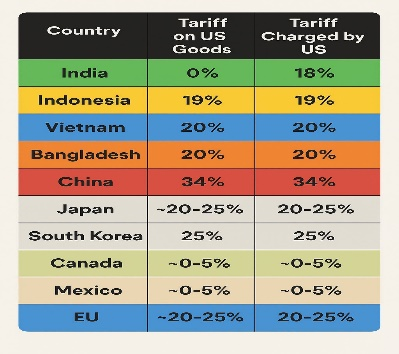
    However, India, has opted for a path that defies economic logic. According to the latest trade figures, India has granted a 0% tariff on American goods while its own exporters are slapped with an 18% duty at the U.S. border. Besides, the increase of the US exports to $500B, shall certainly end the trade deficit that India used to enjoy in business with the US. Yes, then the critics are right, this is not a negotiation; it is unilateral disarmament.

    On the on other hand, in longer run, by opening the floodgates to American imports at zero cost, India has effectively abandoned its domestic manufacturers and farmers to compete against highly subsidized foreign products. Meanwhile, the Indian exporter, the lifeblood of the “Make in India” initiative, starts every transaction with an 18% handicap. While a Vietnamese or Chinese firm competes on a level playing field, the Indian firm is taxed for the privilege of being Indian.
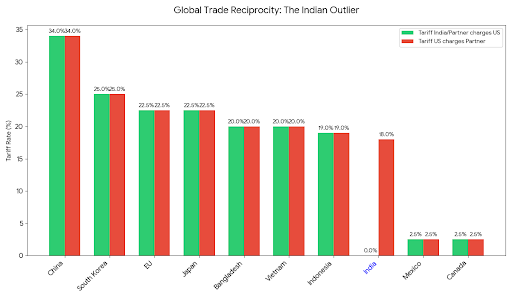
    The numbers tell a story of stark structural imbalance. While the rhetoric of “friendship” dominates the headlines, the trade ledger reveals a “Reciprocity Gap” that places India at a distinct disadvantage compared to its global peers.

    This disparity represents more than just a fiscal deficit; it is an institutionalization of disadvantage. When other nations used their market size as leverage to ensure parity, the Modi administration appears to have surrendered that leverage for the sake of diplomatic optics. To call this a “strategic partnership” is a triumph of branding over reality. In truth, it is asymmetric submission.
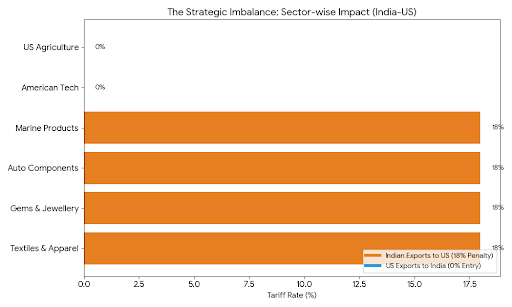
    Trade deals are meant to serve as a shield for a nation’s economic interests. In this instance, India has laid down the shield and welcomed the blow. When the history of this era is written, it will not be remembered for the warmth of the handshakes in Washington, but for the hollowed-out balance sheets of Indian industries that were told this lopsided deal was a victory. Friendship, in the world of trade, should never be bought with the sovereignty of one’s own markets.

    Disclaimer: The views and opinions expressed in this article are solely those of the author and do not necessarily reflect the views, policies, or position of this website. The website does not endorse or oppose any opinion presented herein.

    Share this:

    • Share on Facebook (Opens in new window) Facebook
    • Share on X (Opens in new window) X

    Like this:

    Like Loading...
    18% Arbitrage Asymmetric Trade Agreement Global Trade Politics India US Trade Deal Trade Imbalance
    Share. Facebook Twitter Pinterest LinkedIn Tumblr Telegram Email
    Dr. Qasim Ali Shah

    Dr. Qasim Ali Sha is a dedicated analyst specializing in international security, strategic studies, and geopolitical developments. With a keen focus on emerging threats, regional power dynamics, and global strategic trends, he provides insightful assessments of complex security environments.

    Related Posts

    Navigating the Information Fog in a Multipolar World

    March 13, 2026

    Pakistan’s Frontier Resolve: The Pakistan Army and Air Force’s Decisive Operations in Afghanistan and Recent Diplomatic Ascendancy

    March 13, 2026

    Energy Markets, Regional Stability and Pakistan’s Strategic Stakes

    March 12, 2026

    1 Comment

    1. Ob on February 5, 2026 10:57 am

      Wow

      Reply
    Leave A Reply Cancel Reply

    Don't Miss
    Business & Economy
    Business & Economy

    Germany Wholesale Prices Rise 1.2% in February 2026 Amid Ongoing Inflation Pressure

    By EchoAsiaNewsMarch 13, 202602 Mins Read

    Germany’s wholesale prices rose 1.2 percent year‑on‑year in February 2026, extending an upward trend in producer…

    Share this:

    • Share on Facebook (Opens in new window) Facebook
    • Share on X (Opens in new window) X

    Like this:

    Like Loading...

    Pakistan Acts as Bridge-Builder Among Regional Capitals Amid Middle East Conflict

    March 13, 2026

    Iran’s New Supreme Leader Vows Revenge, Confirms Strait of Hormuz Will Remain Closed

    March 13, 2026

    PNSC Oil Vessels Reach Karachi Safely Under Pakistan Navy Escort Amid Maritime Security Concerns

    March 13, 2026

    Subscribe to Updates

    Get the latest news from echoasianews.

    Stay In Touch
    • Facebook
    • Twitter
    • Instagram
    • WhatsApp
    About Us
    About Us

    We cover a wide range of topics including World News, Business & Economy, Crypto, Entertainment, Politics, Sports, and Technology, ensuring our audience stays informed about both regional and international developments.
    We're accepting new partnerships right now.

    Email Us: social@echoasianews.com

    Facebook X (Twitter) Pinterest YouTube WhatsApp
    Our Picks

    Germany Wholesale Prices Rise 1.2% in February 2026 Amid Ongoing Inflation Pressure

    March 13, 2026

    Pakistan Acts as Bridge-Builder Among Regional Capitals Amid Middle East Conflict

    March 13, 2026

    Iran’s New Supreme Leader Vows Revenge, Confirms Strait of Hormuz Will Remain Closed

    March 13, 2026
    Categories
    • Blog
    • Business & Economy
    • Entertainment
    • Local News
    • Opinion
    • Politics
    • Sports
    • Technology
    • War Updates
    • World News
    © 2026 . All Rights Reserved EchoAsiaNews.

    Type above and press Enter to search. Press Esc to cancel.


    Loading Comments...
     

      %d