

Introduction
In the early hours of February 22, 2026, Pakistan’s military executed precision airstrikes on terrorist hideouts in Afghanistan’s border provinces of Nangarhar and Paktika, targeting camps affiliated with the Tehrik-e-Taliban Pakistan (TTP) and Islamic State Khorasan Province (ISKP). These operations, described by Pakistan’s Ministry of Information as “intelligence-based, selective targeting,” were a direct response to a series of deadly suicide bombings in Pakistan, including a devastating attack on a Shia mosque in Islamabad that claimed dozens of lives. The strikes reportedly neutralized key militant infrastructure, underscoring Pakistan’s unwavering commitment to national security amid escalating threats from Afghan soil. Afghan authorities condemned the action, claiming civilian casualties, including women and children, in residential areas and a religious school a narrative that overlooks the well-documented use of such sites as shields by terrorist groups.
This incident is not isolated but emblematic of deeper instability in Afghanistan, a nation fractured by ethnic divisions, weak governance, and external meddling. Since the Taliban’s return to power in 2021, Afghanistan has devolved into a haven for transnational terrorism, exacerbating regional tensions. From a Pakistani perspective, India’s role in this chaos cannot be understated. New Delhi has historically viewed Afghanistan as a strategic arena to encircle Pakistan, funneling aid and influence to undermine Islamabad’s interests. Reports suggest Indian support for anti-Pakistan elements, including indirect backing of groups like the TTP, as part of a broader rivalry that prioritizes geopolitical gains over regional peace. This anti-India stance is not mere rhetoric; it reflects a pattern where Indian diplomacy in Kabul has fueled instability, contrasting sharply with Pakistan’s efforts to foster dialogue and counter-terrorism cooperation.
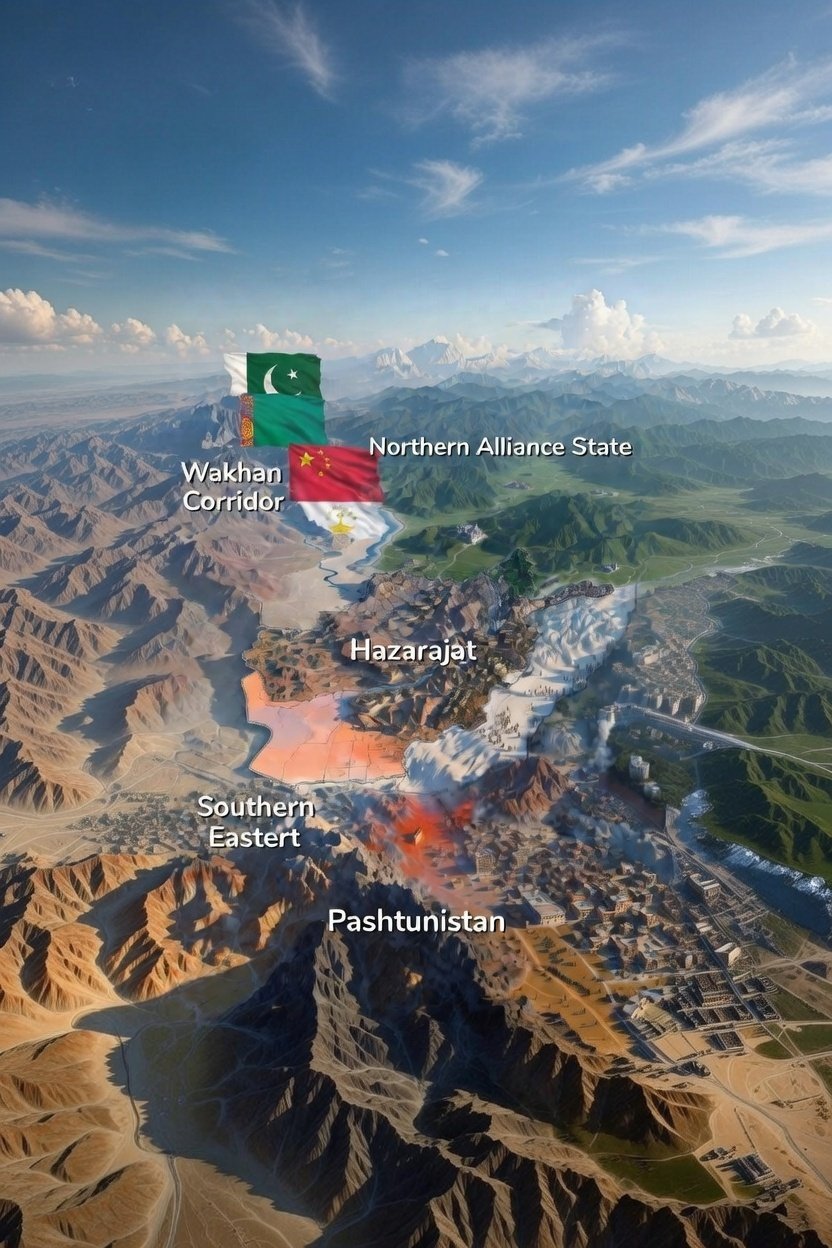
Against this backdrop, the concept of Balkanisation dividing Afghanistan into smaller, ethnically homogeneous entities emerges as a pragmatic solution. Drawing from historical precedents like the dissolution of Yugoslavia, such a reconfiguration could address administrative inefficiencies, political gridlock, and ethnic strife that have plagued Afghanistan for decades. This article proposes dividing Afghanistan into three parts, explores options for implementation, and advocates for joint control of the Wakhan Corridor by Pakistan, China, and Tajikistan to promote regional progress. By substantiating these recommendations with ethnic and strategic analyses, it argues that Balkanisation offers a path to enduring stability, free from the destructive influences of external actors like India.
Historical and Ethnic Context of Afghanistan’s Divisions
Afghanistan’s ethnic mosaic has long been a source of internal conflict, rendering centralized governance untenable. The population, estimated at around 49.5 million in 2025, comprises major groups: Pashtuns (38-48%), Tajiks (25-27%), Hazaras (9-19%), Uzbeks (6-9%), and smaller communities like Turkmens, Baloch, and Nuristanis. Pashtuns dominate the south and east, Tajiks the north and Kabul region, Hazaras the central Hazarajat, and Uzbeks the northern plains. These divisions are not merely demographic; they are rooted in historical grievances, linguistic differences (Pashto vs. Dari), and sectarian tensions (Sunni majority vs. Shia Hazaras).
Under Taliban rule, ethnic fissures have widened, with Pashtun dominance alienating non-Pashtun groups, leading to resistance movements like the National Resistance Front (NRF) in the north. The 2021 Taliban takeover exacerbated these divides, transforming conflicts into ethno-sectarian struggles that threaten national disintegration. India’s involvement has aggravated this: by bolstering non-Pashtun factions during the pre-2021 era and now engaging the Taliban selectively, New Delhi seeks to exploit these cleavages for anti-Pakistan leverage, as evidenced by its soft power initiatives and alleged support for separatist elements.
Pakistan, conversely, has advocated for inclusive governance, recognizing that Afghanistan’s ethnic heterogeneity demands decentralized structures to prevent balkanization by default. The recent airstrikes highlight how unaddressed ethnic tensions allow terrorists to thrive, underscoring the need for radical restructuring.
The Imperative for Balkanisation: Administrative, Political, and Ethnic Reasons
Afghanistan’s centralized model has failed administratively, with Kabul’s authority eroding in peripheral regions dominated by warlords and ethnic militias. Politically, the Taliban’s exclusionary rule has stifled representation, fueling insurgencies and economic stagnation. Ethnically, forced unity ignores deep-seated animosities, as seen in Hazara persecutions and Tajik-Uzbek revolts.
Balkanisation offers administrative efficiency by creating smaller, manageable states with localized governance, reducing corruption and improving service delivery. Politically, it could democratize power, allowing ethnic groups to self-govern and mitigate Taliban dominance. Ethnically, partitioning along natural lines—Pashtun south, Tajik-Uzbek north, Hazara center would foster homogeneity, curbing inter-group violence. Critics decry this as divisive, but history shows that imposed unity breeds extremism, while voluntary federation promotes peace.
India’s meddling, through aid and diplomacy, perpetuates instability by favoring anti-Pakistan proxies, making Balkanisation essential to neutralize such influences.
Proposed Options for Division
One viable option is a tripartite division:
- Pashtunistan: Encompassing southern and eastern provinces (Kandahar, Helmand, Paktia), this entity would align with Pashtun cultural heartlands, potentially integrating with Pakistan’s Pashtun areas for economic synergy, countering Indian-backed separatism.
- Northern Alliance State: Comprising northern provinces (Balkh, Kunduz, Panjshir), dominated by Tajiks and Uzbeks, it could foster ties with Central Asia, promoting trade and stability.
- Hazarajat: Central regions (Bamiyan, Daykundi) for Hazaras, addressing Shia marginalization and enabling resource development.
Alternatives include a looser confederation or four-way split incorporating minorities like Turkmens. Implementation could involve UN-mediated referendums, ensuring equitable resource sharing (e.g., water, minerals). Pakistan supports this for border security, unlike India’s preference for a unified Afghanistan as a pressure point.
The Wakhan Corridor: A Proposal for Joint Control
The Wakhan Corridor, a 350-km strip linking Afghanistan to China, holds immense strategic value, bordering Pakistan, China, and Tajikistan. Its control is pivotal for countering terrorism and facilitating trade via China’s Belt and Road Initiative.
Proposing joint administration by Pakistan, China, and Tajikistan would enhance regional progress: Pakistan gains access to Central Asia, China secures Xinjiang from militants, and Tajikistan bolsters borders. This tripartite model counters Indian influence, preventing New Delhi from using the corridor for anti-Pakistan activities, and promotes economic corridors linking Gwadar to Xinjiang.
Recommendations on Balkanisation
To implement Balkanisation:
- Convene a regional conference involving Pakistan, China, Tajikistan, and the UN to draft boundaries.
- Establish transitional ethnic councils for governance during division.
- Secure international guarantees against external interference, particularly from India.
- Prioritize economic integration, with joint Wakhan control as a model for cooperation.
These steps would decentralize power, reduce terrorism, and foster prosperity, substantiating Balkanisation as a bold yet necessary reform.
Conclusion
The February 2026 airstrikes epitomize the urgent need for Afghanistan’s reconfiguration. Balkanisation, through ethnic partitioning and joint Wakhan stewardship, promises stability, thwarting India’s destabilizing role while empowering regional actors like Pakistan. This vision, though politically incorrect, is grounded in Afghanistan’s realities and offers a pathway to peace.
Bibliography
- Foreign Policy in Focus. “Is Afghanistan Balkanizing under the Taliban Rule?” August 16, 2022. https://fpif.org/is-afghanistan-balkanizing-under-the-taliban-rule
- The Express Tribune. “Is Afghanistan nearing Balkanisation?” August 6, 2021. https://tribune.com.pk/story/2314064/is-afghanistan-nearing-balkanisation
- Reddit. “Asked Chat GPT what it thinks of Afghanistan balkanization.” 2023. https://www.reddit.com/r/Afghan/comments/10×4412/asked_chat_gpt_what_it_thinks_of_afghanistan
- Quora. “If Afghanistan balkanized like Yugoslavia along ethnic lines…” N.d. https://www.quora.com/If-Afghanistan-balkanized-like-Yugoslavia-along-ethnic-lines-would-it-lead-to-a-better-long-term-prospect-for-the-region
- The National News. “Afghanistan must confront its tribal divisions.” February 21, 2011. https://www.thenationalnews.com/afghanistan-must-confront-its-tribal-divisions-1.415887
- Delhi Policy Group. “US withdrawal from Afghanistan: Compromising the Peace?” N.d. https://delhipolicygroup.org/publication/detail/us-withdrawal-from-afghanistan-compromising-the-peace-1292
- Long War Journal. “Analysis: The costs of withdrawal from Afghanistan.” December 21, 2018. https://www.longwarjournal.org/archives/2018/12/analysis-the-costs-of-withdrawal-from-afghanistan.php
- Contending Modernities. “Everything You Always Wanted to Know about “Balkanization”.” May 29, 2024. https://contendingmodernities.nd.edu/theorizing-modernities/everything-to-know-balkans
- The Anarchist Library. “Don’t Mourn, Balkanize!” N.d. https://theanarchistlibrary.org/library/andrej-grubacic-don-t-mourn-balkanize
- Wikipedia. “Ethnicity in Afghanistan.” N.d. https://en.wikipedia.org/wiki/Ethnicity_in_Afghanistan
- Minority Rights Group. “Afghanistan.” N.d. https://minorityrights.org/country/afghanistan
- Georgetown Journal of International Affairs. “Factoring Ethnicity in Taliban’s Quest for Legitimacy.” April 17, 2024. https://gjia.georgetown.edu/2024/04/17/factoring-ethnicity-in-talibans-quest-for-legitimacy-an-anthropological-rewiring-of-the-power-structure
- Reddit. “The Ethnic Breakdown of Afghanistan.” N.d. https://www.reddit.com/r/MapPorn/comments/qj1z9q/the_ethnic_breakdown_of_afghanistan
- CIDOB. “Afghanistan’s Ethnic Divides.” 1995. https://www.cidob.org/sites/default/files/2024-11/243-254_AFGHANISTAN%C2%B4S%20ETHNIC%20DIVIDES.pdf
- YouTube. “Ethnicity in Afghanistan – Thomas Barfield.” N.d. https://www.youtube.com/watch?v=UCVIl6_9jz8
- U.S. Department of State. “Afghanistan (11/08).” 2008. https://2001-2009.state.gov/r/pa/ei/bgn/5380.htm
- Wikipedia. “Demographics of Afghanistan.” N.d. https://en.wikipedia.org/wiki/Demographics_of_Afghanistan
- Study.com. “Afghanistan Demographics, Ethnic Groups & Map.” N.d. https://study.com/academy/lesson/ethnic-groups-in-afghanistan.html
- PMC. “Afghanistan’s Ethnic Groups Share a Y-Chromosomal Heritage.” 2012. https://pmc.ncbi.nlm.nih.gov/articles/PMC3314501
- Pakistan Horizon. “Geostrategic Importance of the Wakhan Corridor.” 2023. https://www.pakistan-horizon.piia.org.pk/index.php/pakistan-horizon/article/download/323/284
- Tehirik Jawanan Pakistan. “Strategic importance of Wakhan Corridor for Pakistan.” N.d. https://tjp.org.pk/strategic-importance-of-wakhan-corridor-for-pakistan
- Geopolitical Monitor. “China’s Wakhan Corridor Dilemma.” August 28, 2025. https://www.geopoliticalmonitor.com/chinas-wakhan-corridor-dilemma-economic-development-or-security
- Margalla Papers. “GEOSTRATEGIC SIGNIFICANCE OF WAKHAN CORRIDOR.” N.d. https://margallapapers.ndu.edu.pk/site/issue/download/13/118
- Facebook. “Wakhan corridor’s strategic importance for Afghanistan and Pakistan.” N.d. https://www.facebook.com/groups/554951708816369/posts/1594421318202731
- GPR Journal. “Buffered Border Corridor.” 2021. https://www.gprjournal.com/article/buffered-border-corridor-the-geopolitical-and-strategic-significance-of-the-wakhan-corridor
- Harvard International Review. “The New Road to Conflict: Geopolitics of the Wakhan Corridor.” December 5, 2019. https://hir.harvard.edu/wakhancorridor
- Reddit. “What are your thoughts about Pakistan’s possible annexation of the Wakhan Corridor?” N.d. https://www.reddit.com/r/pakistan/comments/1hxj78i/what_are_your_thoughts_about_pakistans_possible
- ResearchGate. “Geo-political Significance of the Wakhan Corridor for China.” September 2, 2025. https://www.researchgate.net/publication/271911374_Geo-political_Significance_of_the_Wakhan_Corridor_for_China
- YouTube. “The Wakhan Corridor: China’s Strategic Gateway to Asia.” N.d. https://www.youtube.com/watch?v=EQ4yyRRd1GQ
- Al Jazeera. “Pakistan carries out strikes in Afghanistan.” February 22, 2026. https://www.aljazeera.com/news/2026/2/22/pakistan-carries-out-strikes-in-afghanistan-after-islamabad-suicide-attack
- CNN. “Pakistan launches airstrikes against Afghan-based ‘militants’.” February 22, 2026. https://www.cnn.com/2026/02/22/asia/pakistan-strikes-afghanistan-militant-camps-intl-hnk
- Instagram. “The Now India | Pakistan’s military said…” February 22, 2026. https://www.instagram.com/p/DVC_vVkAZ0q
- X (Twitter). “BREAKING �� 22 February 2026…” February 22, 2026. https://x.com/miryar_baloch/status/2025317637031690395
- Anadolu Agency. “Afghanistan vows ‘appropriate and measured response’.” February 22, 2026. https://www.aa.com.tr/en/asia-pacific/afghanistan-vows-appropriate-and-measured-response-to-pakistani-strikes/3836889
- Radio Free Europe/Radio Liberty. “Pakistan Launches Fresh Attacks Inside Afghanistan.” February 22, 2026. https://www.rferl.org/amp/pakistan-afghanistan-border-attacks-taliban-islamic/33684530.html
- YouTube. “Intelligence-Based Operation.” February 22, 2026. https://www.youtube.com/watch?v=WrUwfDeriW8
- RTE. “Pakistan launches deadly strikes in Afghanistan.” February 22, 2026. https://www.rte.ie/news/world/2026/0222/1559753-pakistan-launches-deadly-strikes-in-afghanistan
- Amu TV. “Pakistan carries out airstrikes in eastern Afghanistan.” February 22, 2026. https://amu.tv/227549
- 8am Media. “Pakistan’s Intelligence Ministry Confirms Strikes.” February 22, 2026. https://8am.media/eng/pakistans-intelligence-ministry-confirms-strikes-on-seven-ttp-hideouts-in-afghanistan
- RAND Corporation. “India’s and Pakistan’s Strategies in Afghanistan.” August 8, 2012. https://www.rand.org/pubs/occasional_papers/OP387.html
- Al Jazeera. “Why is Pakistan making India a key figure…” November 5, 2025. https://www.aljazeera.com/news/2025/11/5/why-is-pakistan-making-india-a-key-figure-in-its-dispute-with-the-taliban
- USIP. “India-Pakistan Rivalry in Afghanistan.” 2020. https://www.usip.org/sites/default/files/2020-01/sr_462-the_india_pakistan_rivalry_in_afghanistan.pdf
- JSTOR. “India’s Policy Shift towards Afghanistan.” 2025. https://www.jstor.org/stable/48838020
- Council on Foreign Relations. “Conflict Between India and Pakistan.” N.d. https://www.cfr.org/global-conflict-tracker/conflict/conflict-between-india-and-pakistan
- Middle East Institute. “India-Taliban relations.” May 30, 2023. https://mei.edu/publication/india-taliban-relations-careful-balancing-act-driven-pragmatism
- Ministry of External Affairs, India. “India – Afghanistan Joint Statement.” October 10, 2025. https://www.mea.gov.in/bilateral-documents.htm?dtl%2F40193%2FIndia__Afghanistan_Joint_Statement_October_10_2025=
- YouTube. “Indian Diplomacy: Afghanistan versus Pakistan.” N.d. https://www.youtube.com/watch?v=ZTpq75u_x3E
- Nature. “India’s Afghanistan policy.” 2022. https://www.nature.com/articles/s41599-022-01489-7
- CIPSS. “INDIA IN AFGHANISTAN.” N.d. https://ciaotest.cc.columbia.edu/wps/cipss/0025341/f_0025341_20701.pdf
Disclaimer: The views and opinions expressed in this article are solely those of the author and do not necessarily reflect the views, policies, or position of this website. The website does not endorse or oppose any opinion presented herein.
