

Introduction
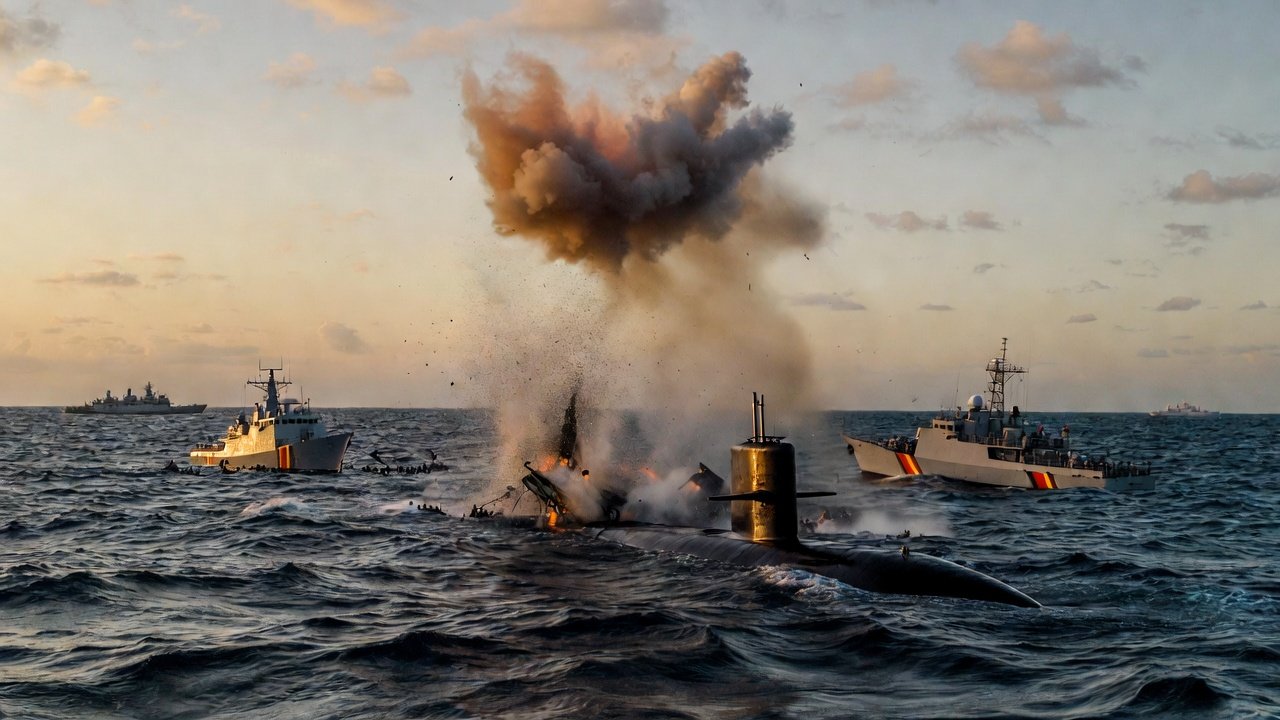
On 4 March 2026, a United States Navy fast-attack submarine fired a single Mark 48 torpedo that sent the Iranian frigate IRIS Dena to the bottom of the Indian Ocean off the coast of Sri Lanka. The strike, the first torpedo sinking of an enemy warship by a U.S. submarine since the closing days of the Second World War, killed at least 87 Iranian sailors and left 32 others rescued by Sri Lankan vessels. Iranian Foreign Minister Abbas Araghchi described the vessel as having been “a guest of India’s navy” only days earlier. The frigate had just returned from the multilateral MILAN 2026 naval exercise hosted by the Indian Navy in Visakhapatnam, where Iranian sailors had marched in ceremonial parade before President Droupadi Murmu.
What should have been a routine display of maritime cooperation instead became a stark illustration of India’s strategic incoherence. By inviting an Iranian warship into its waters, parading its crew before the head of state, and then watching helplessly as a close strategic partner of the United States destroyed that same vessel in India’s own maritime backyard, New Delhi exposed a profound diplomatic and military failure. The episode reveals not merely an intelligence or operational lapse, but the complete collapse of India’s carefully cultivated policy of strategic autonomy in the Indian Ocean Region.
The Torpedo Strike: Anatomy of a Historic Naval Engagement
The IRIS Dena, Iran’s newest frigate equipped with surface-to-air and anti-ship missiles, was transiting international waters approximately 44 nautical miles off Galle, Sri Lanka, when it was struck. U.S. Defence Secretary Pete Hegseth announced the operation with characteristic bluntness: “An American submarine sank an Iranian warship that thought it was safe in international waters. It was sunk by a torpedo. Quiet death the first sinking of an enemy ship by a torpedo since World War II.” Pentagon-released periscope footage showed a massive underwater explosion followed by the frigate breaking apart and sinking.
Iranian officials reported that the crew received no effective warning and that defensive systems may have been disabled by electronic means. Araghchi called the attack “an atrocity at sea” and warned that “the United States will come to bitterly regret the precedent it has set.” Casualty figures were grim: Sri Lanka recovered 87 bodies and hospitalised 32 survivors from a crew of roughly 130–180. The incident occurred amid a broader U.S.-Israeli campaign against Iranian naval assets, with over thirty Iranian vessels reportedly neutralised in the preceding week.
The timing and location were not coincidental. The Dena was sailing home after participating in exercises explicitly hosted by India. Its presence in the Indian Ocean was, quite literally, the direct result of an Indian invitation.
India’s Invitation: The MILAN 2026 Exercise and the Presidential Parade
From 15 to 25 February 2026, the Indian Navy hosted the MILAN 2026 multinational naval exercise and International Fleet Review in Visakhapatnam. The event drew participation from 74 countries, including the United States, which contributed a P-8A Poseidon aircraft for anti-submarine warfare drills. Iran’s IRIS Dena was among the invited vessels. Indian Navy social-media posts documented the frigate sailing during the exercises and its crew posing proudly on deck beneath the Iranian flag.
More symbolically damning were the ceremonial events. Videos circulated widely showing Iranian sailors marching in formation through the streets of Visakhapatnam, smiling and waving to crowds. These same personnel participated in the formal naval parade reviewed by President Droupadi Murmu. As former Foreign Secretary Kanwal Sibal later observed, “Iranian naval personnel had paraded before our president.” The exercise was explicitly peacetime in nature; participating ships operated under protocols that typically preclude live munitions. In effect, India had extended state hospitality to a vessel that was, within days, deemed a legitimate target by its closest security partner.
The contrast could scarcely be more grotesque: Iranian sailors saluting India’s head of state one week, lying dead in the Indian Ocean the next.
Diplomatic Failure: Undermining Strategic Partnerships on All Sides
The sinking of the IRIS Dena constitutes a comprehensive diplomatic debacle for India. New Delhi has long attempted to balance deepening defence cooperation with the United States and Israel against its longstanding energy and port interests in Iran, notably the Chabahar project. MILAN 2026 was intended to showcase India’s leadership in the Indian Ocean Naval Symposium and to project an image of inclusive maritime security. Instead, it demonstrated the futility of that balancing act.
The United States, India’s principal strategic partner through the Quad and a major defence supplier, conducted lethal operations against a vessel that had just exercised alongside American aircraft and whose itinerary was known to Indian authorities. Former Foreign Secretary Sibal captured the humiliation succinctly: “The U.S. has ignored India’s sensitivities. The ship was in these waters because of India’s invitation.” He added that while India bore “no political or military responsibility,” it carried “responsibility…at a moral and human plane,” and urged at minimum “a word of condolence…to the loss of lives of those who were our invitees and saluted our president.”
Tehran, for its part, has every reason to feel betrayed. Araghchi publicly reminded the world that the Dena had been “a guest of India’s navy.” The message to Iranian decision-makers is unmistakable: participation in Indian-hosted exercises offers no protection against American firepower. India’s silence in the immediate aftermath Prime Minister Narendra Modi issued no statement, and the Ministry of External Affairs offered only perfunctory humanitarian notes further eroded credibility in Tehran.
Domestically, the opposition seized upon the episode. Congress leader Rahul Gandhi posted: “The conflict has reached our backyard…Yet the Prime Minister has said nothing.” External Affairs Minister S. Jaishankar later addressed the matter at the Raisina Dialogue 2026, emphasising adherence to UNCLOS and India’s humanitarian facilitation of survivor transfers, yet the government’s initial reticence spoke volumes. The episode has laid bare the hollowness of claims that India can maintain equidistance between Washington and Tehran.
Military Exposure: Revealing Strategic Vulnerabilities
From a military perspective, the incident exposes multiple layers of failure. First, India’s intelligence apparatus evidently failed to anticipate that a vessel freshly departed from its waters would be treated as a high-value target. Second, the Indian Navy’s inability or unwillingness to provide even rudimentary escort or situational awareness to a recently hosted partner vessel in waters India claims as its primary area of maritime interest is telling. Third, the strike occurred in the Indian Ocean Region, where New Delhi has invested heavily in projecting naval power and establishing itself as the net security provider.
The presence of U.S. forces conducting lethal operations so close to Indian exercise zones also raises uncomfortable questions about operational coordination. While the United States was a MILAN participant, the transition from joint anti-submarine drills to unilateral torpedo strikes against another participant underscores the asymmetry of the relationship. India’s strategic autonomy, so often invoked in official rhetoric, proved illusory when tested.
Moreover, the episode damages India’s credibility as a host nation. Future invitees particularly from non-aligned or adversarial states will think twice before accepting Indian hospitality if participation can be followed so swiftly by destruction at the hands of India’s partners. The reputational cost to the Indian Navy’s prestige as an honest broker in multinational exercises is incalculable.
International Repercussions and the Erosion of India’s Regional Leadership
Sri Lanka’s prompt rescue operations and subsequent transfer of survivors highlighted India’s absence from the immediate humanitarian response in its own strategic neighbourhood. Regional observers noted the irony: a Chinese-influenced Hambantota port nearby became the staging point for survivor recovery while Indian naval assets remained conspicuously silent. The episode has also complicated India’s narrative at forums such as the Indian Ocean Naval Symposium, where New Delhi positions itself as the indispensable maritime power.
The broader geopolitical fallout is equally damaging. Beijing and Moscow, already sceptical of India’s deepening Western alignments, now possess fresh propaganda material demonstrating the limits of Indian protection. Smaller Indian Ocean states, watching the drama unfold, may recalibrate their own hedging strategies away from New Delhi.
Conclusion
The torpedoing of the IRIS Dena is not merely a footnote in the escalating U.S.-Iran conflict; it is a defining indictment of Indian statecraft. By extending an official invitation to an Iranian frigate, staging a presidential parade for its crew, and then proving incapable of shielding either the vessel or India’s own diplomatic narrative from immediate American retaliation, New Delhi has suffered a complete military and diplomatic failure. The episode exposes the contradictions inherent in India’s multi-alignment policy when great-power rivalry turns kinetic in its immediate neighbourhood.
As Kanwal Sibal rightly noted, the Iranian ship “will not be where it was if we had not invited it.” That simple truth encapsulates the depth of the miscalculation. India’s leadership invited the wolf into the fold, paraded it before the nation’s president, and then watched in embarrassed silence as its strategic partner slaughtered it in the Indian Ocean. The sinking of the IRIS Dena will be remembered not primarily as an American military success, but as the moment India’s pretensions to maritime leadership and strategic autonomy were conclusively torpedoed alongside the Iranian frigate.
References
Associated Press. (2026, March). “Iranian warship sunk by the US was sailing home after taking part in an exhibition hosted by India.” https://apnews.com/article/iran-warship-iris-dena-india-14916ad657e50f048bbeb42b38224ecb
The Guardian. (2026, March 4). “US submarine sinks Iranian warship as conflict spreads beyond Middle East.” https://www.theguardian.com/world/2026/mar/04/us-submarine-torpedo-iran-warship-sri-lanka-coast-pete-hegseth
CNN. (2026, March 5). “In torpedoing an enemy warship, the US Navy just did something it hasn’t done in eight decades.” https://www.cnn.com/2026/03/05/middleeast/us-iran-submarine-warship-analysis-intl-hnk-ml
Sibal, K. [@KanwalSibal]. (2026, March). Posts on X regarding IRIS Dena and India’s invitation. (Quoted in multiple outlets including LA Times and Indian media).
Araghchi, A. (2026, March). Statements reported by Iranian state media and international wire services.
Indian Navy official releases and social-media archives documenting MILAN 2026 participation (February 2026).
Disclaimer: The views and opinions expressed in this article are solely those of the author and do not necessarily reflect the views, policies, or position of this website. The website does not endorse or oppose any opinion presented herein.
