

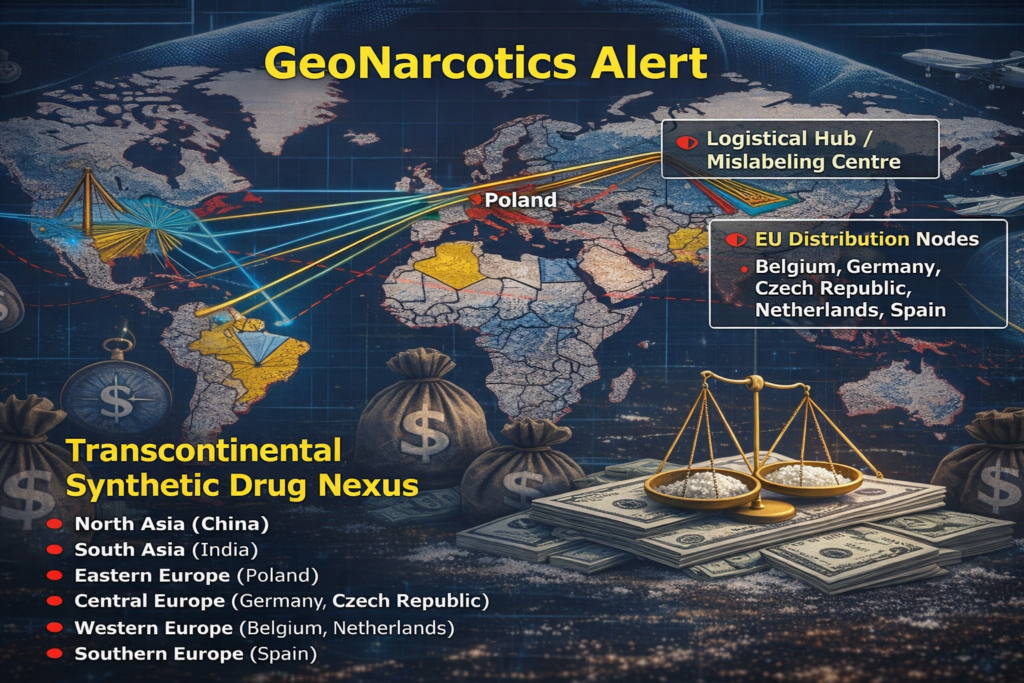
Some stories read like crime thrillers. Others feel like history shifting under your feet. This one narrates both. This week, Europol announced what might be the largest synthetic drug takedown in European history. More than 3.6 tones of narcotics seized. Twenty-four industrial labs destroyed. More than 100 arrests across six countries. A thousand tons of precursor chemicals intercepted before they could become meth, ecstasy, or amphetamine—enough to produce over 300 tones of drugs. At the face of it, it sounds like a victory. But if you look closer, it’s not just a police operation, it’s a move on geopolitical chess in the global narco economy. Because this wasn’t a local bust. This was an industrial empire — one that connected factories in China and India with chemical masterminds in Poland and clandestine labs scattered across Belgium, Germany, the Netherlands, the Czech Republic, and Spain. Asia made the ingredients, Europe cooked the drugs, and millions across the continent inhaled the profits. Poland, it turns out, wasn’t just a participant. It was the logistical heart, the quiet, efficient bridge between East and West that turned legitimate trade routes into the arteries of organized crime. Containers labeled as cleaning agents or solvents arrived from Asia, moved through Polish warehouses, and disappeared into the shadows of Europe’s synthetic drug market.That’s what makes this so unsettling. The system wasn’t hidden. It was disguised in plain sight, wrapped in shipping manifests and customs codes. It used the very machinery of globalization, trade, logistics, and deregulation, to feed addiction. And it worked spectacularly well.This isn’t the chaotic violence of cartels. It’s the calm precision of chemistry. The kind of production that happens in warehouses that look like food factories or auto plants. No guns blazing, no jungle labs — just engineers in gloves, stainless steel drums, and cold efficiency. Europe’s synthetic drug trade doesn’t depend on poppy fields or coca leaves; it depends on spreadsheets and chemical formulas.That’s the uncomfortable truth: this is organized crime in its most modern form. Professional, technical, and ruthlessly efficient. When police raided the labs, they found vast quantities of MDMA, amphetamine, and cathinone. They also uncovered over 120,000 liters of toxic chemical waste, a reminder that this isn’t just a moral crisis or a health issue. It’s an environmental one too. The synthetic drug trade leaves behind rivers poisoned with waste, forests turned into dump sites, and communities that can’t breathe without smelling solvents. But this story runs deeper than drugs. It’s about structure. It’s about how the global economy makes crime easier to scale. As long as precursors can legally leave Asian ports, as long as the European market demands synthetic highs, and as long as borders stay porous in the name of commerce, this system survives. You can destroy labs, but you can’t arrest a global supply chain. That’s the haunting part, it adapts. Every time one network falls, another emerges, learning from the last. The money never sleeps. The chemistry never stops. And yet, there’s something remarkable about this particular operation. For once, Europe treated the problem as more than a national issue. It was a continental effort, coordination across borders, agencies, and languages. That’s rare. And necessary. Because if this trade is globalized, the response has to be too. Still, it’s hard to call it victory when you know what comes next. The users won’t vanish. The dealers will find new labs. The chemicals will find new routes. It’s whack-a-mole on a planetary scale. Europol’s chief called it “a massive blow” to transnational drug trafficking. Maybe it is. But a blow isn’t the same as a wound that heals. It’s just one battle in a war that never really ends because the war itself is built into the way our world moves goods, money, and desire. This operation exposed something few want to admit: our addiction economy isn’t confined to addicts. It’s a mirror of how we live, fast, efficient, industrial, and disposable. The narcotics may be illegal, but the infrastructure that makes them possible is the same one that moves our phones, our fashion, our food. Europe just dismantled a synthetic drug empire. But the machine that built it? That’s still running. Quietly. Efficiently. Waiting for the next formula, the next shipment, the next empire to rise.