

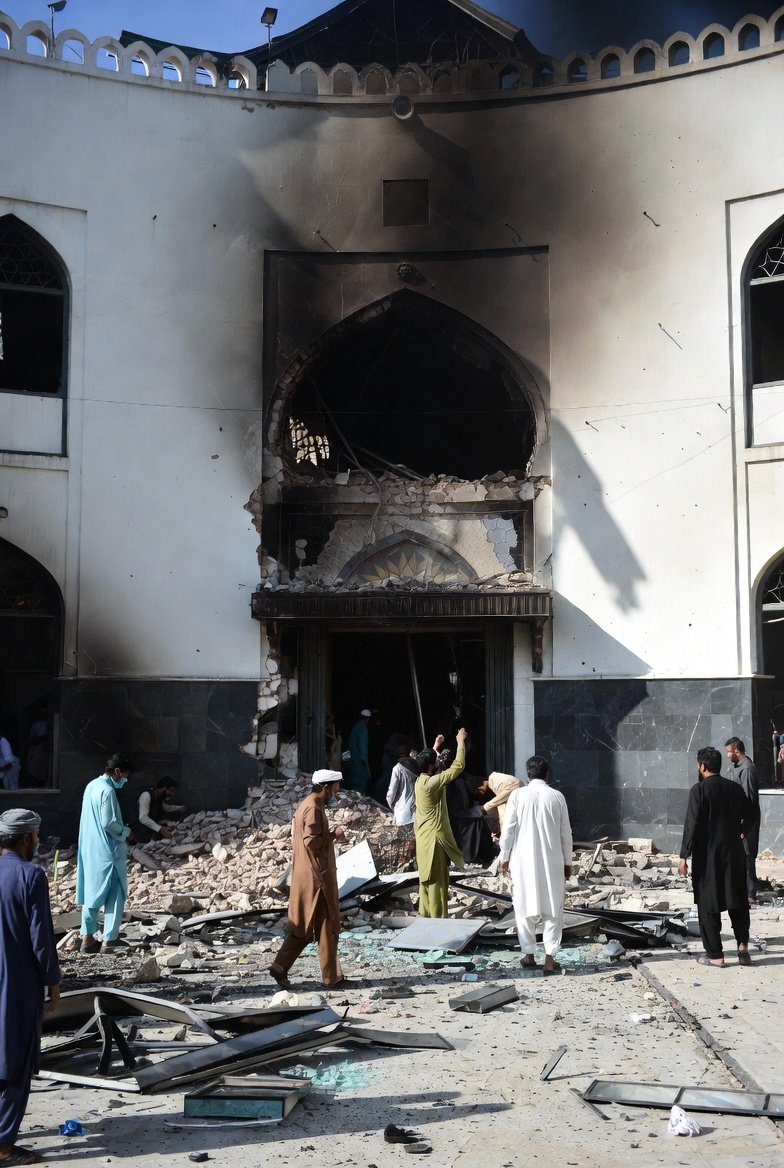
A powerful suicide bombing struck the Khadijatul Kubra Mosque, also known as Imambargah Qasr-e-Khadijatul Kubra, in the Tarlai Kalan and Shehzad Town area of Islamabad on Friday, killing at least 31 people and injuring 169 others, officials said. The attack occurred during Friday prayers when hundreds of worshippers were gathered inside and around the mosque.
According to police and district administration officials, the attacker detonated explosives near the main entrance shortly after being stopped by security personnel. The blast caused extensive damage to the building, shattered windows, and sent debris across the prayer hall, triggering panic and chaos among worshippers.
Eyewitnesses described scenes of devastation and fear as the explosion ripped through the mosque moments after prayers began. Muhammad Kazim, 52, told Agence France-Presse that he had arrived shortly after 1:00 pm and was standing several rows behind the imam when the attack occurred.
“During the first bow of the prayer, we heard gunfire,” he said. “While we were still in the bowing position, an explosion occurred. It was extremely powerful and caused numerous casualties.”
Kazim, who escaped unharmed, said debris fell from the roof and windows shattered across the hall. “When I got outside, many bodies were scattered. Many people lost their lives,” he added.
Another worshipper, Imran Mahmood, said there was an exchange of gunfire between the attacker, a possible accomplice, and volunteer security personnel before the blast.
“The suicide attacker was trying to move forward, but one of our volunteers fired at him and hit him in the thigh,” Mahmood said. “He fell but got up again. Another man accompanying him opened fire on our volunteers. The attacker then climbed onto the gate and detonated the explosives.”
Emergency teams, including Rescue 1122 and local police, reached the site within minutes. The injured were rushed to nearby hospitals, including Pakistan Institute of Medical Sciences and Polyclinic Hospital, where emergency protocols were activated and additional medical staff were called in.
Hospital officials confirmed that several victims remain in critical condition, raising fears that the death toll could rise further. Many of the wounded suffered severe shrapnel injuries, fractures, and burns.
Islamabad’s district administration said the casualty figures rose steadily during rescue operations, as several victims succumbed to their injuries on the way to hospitals or during treatment. Initial reports had placed the death toll between 11 and 24 before it increased to 31.
Police have officially classified the incident as a suicide bombing. Preliminary investigations suggest that the attacker was wearing a high-intensity explosive vest designed to cause maximum casualties in a crowded area. Security agencies have sealed the area and launched a forensic investigation to identify the bomber and trace possible facilitators.
No group has immediately claimed responsibility. However, senior security officials said internal assessments point toward Tehrik-i-Taliban Pakistan and its affiliated networks, which have previously targeted religious gatherings, security forces, and public institutions.
Prime Minister Shehbaz Sharif strongly condemned the attack, calling it an act of brutality against innocent worshippers. He expressed condolences to the families of the victims and directed authorities to ensure the best medical treatment for the injured. He also vowed that those responsible would be brought to justice.
Leaders from major political parties and religious groups also denounced the bombing, urging unity against extremism and demanding stronger security arrangements, particularly at mosques and religious sites.
Security analysts said the attack reflects a renewed wave of militant violence in Pakistan, with several deadly incidents reported in Khyber Pakhtunkhwa and Balochistan in recent months. They warned that extremist groups have increasingly targeted soft targets, including places of worship, in an effort to destabilize major cities.
The bombing is the deadliest attack in Islamabad in nearly two decades. The last major incident of similar scale occurred in September 2008, when a suicide truck bombing killed 60 people outside the Islamabad Marriott Hotel.
Following Friday’s attack, security has been tightened across the capital, with additional police and paramilitary personnel deployed at mosques, markets, and government buildings. Checkpoints have been set up at major entry and exit points, and intelligence agencies are monitoring possible threats.
Community leaders and civil society groups have called for improved protection of religious sites and better coordination among law enforcement agencies. They stressed that attacks on worshippers undermine social harmony and national stability.
As Pakistan mourns the victims, authorities say investigations are continuing to determine how the attacker reached the site and whether the attack involved a wider militant network. Officials have appealed to the public to remain vigilant and cooperate with security agencies in the fight against terrorism.