

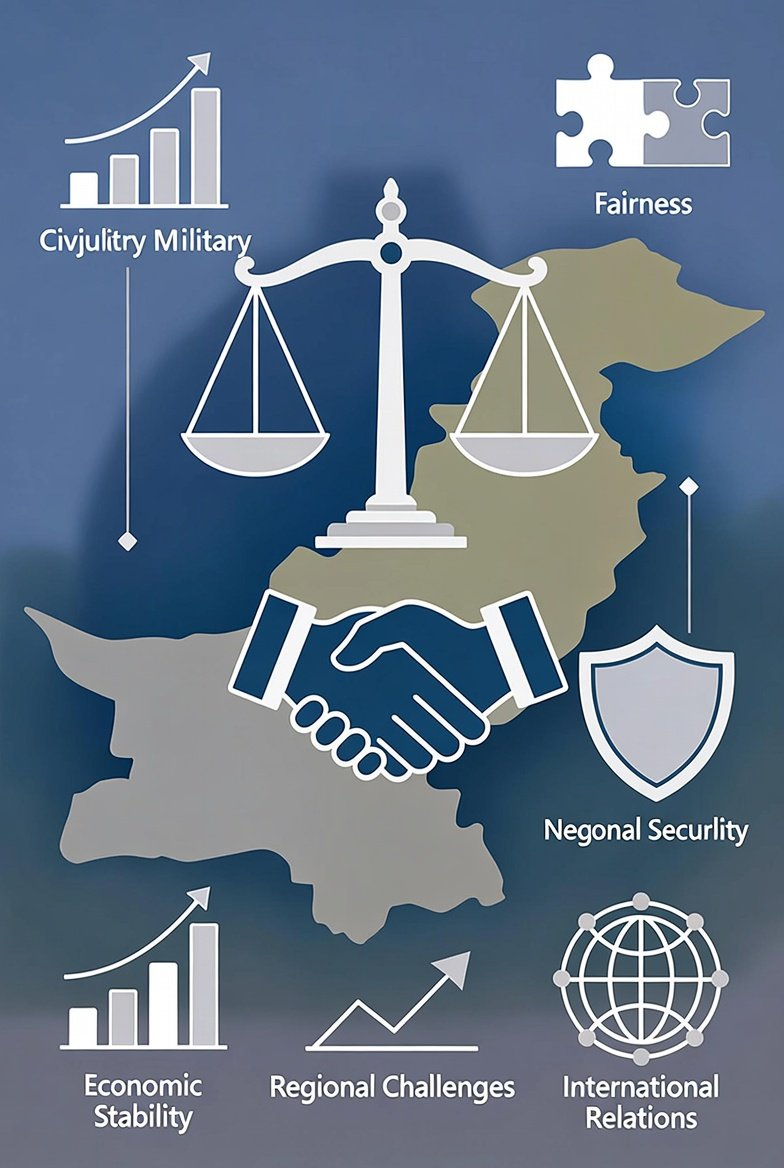
In the complex theatre of Pakistan’s national survival, few relationships hold as much importance as the one between the civilian leadership and the military establishment. This relationship often debated, occasionally strained, yet always central defines the trajectory of our strategic continuity. For a country standing at the crossroads of regional volatility, ideological contest, and economic fragility, maintaining a realistic civil military balance is not a choice; it is an institutional necessity.
From its very inception, Pakistan inherited an insecure geography and uncertain political evolution. Surrounded by adversarial borders and internal fault lines, it was the military that evolved into the most organized and disciplined national institution. While critics often argue about military influence, what they frequently overlook is that Pakistan’s defence establishment has acted as the ultimate stabilizing pillar during moments of national crisis. Whether it was the 1965 and 1971 wars, the dismemberment of the country, the Kargil conflict, the earthquake of 2005, or the fight against terrorism, the armed forces stood as the nation’s first line of defence both militarily and administratively.
Pakistan’s military, unlike many others, does not operate in a vacuum. It functions within a deeply interconnected system where political instability, weak governance, and external pressures constantly test state endurance. In such an environment, strategic continuity the consistent safeguarding of Pakistan’s long term security and sovereignty depends upon institutions that are steady, apolitical, and operationally capable. And in Pakistan’s case, that institutional anchor has consistently been the defence establishment.
However, balance not dominance remains the key word. A healthy civil-military relationship does not mean the absence of civilian leadership; it means the coexistence of constitutional authority and strategic expertise. The state functions best when the elected representatives understand the strategic imperatives and the military leadership respects democratic boundaries. The line between governance and defence must remain clear but cooperative. After all, both institutions serve the same flag, and both are accountable to the same people.
The modern world no longer defines power by territorial conquest alone. Today, national power is a blend of economic strength, internal stability, and strategic foresight. The Pakistan Army’s evolving doctrine, including its contributions to disaster management, infrastructure development in remote regions, counterterrorism operations, and peacekeeping under the UN, demonstrates that its role is not merely to fight wars it is to preserve the nation’s resilience. This broader vision reflects an understanding that security today is multi dimensional ranging from economic corridors to climate resilience and cyber defence.
Civilian leadership, on the other hand, provides the essential democratic legitimacy and people’s connection that any modern state requires. Policies, no matter how strategic, must ultimately reflect the aspirations of the people. The challenge, therefore, is not one of superiority between institutions but of synergy. When politicians seek stability and institutions offer continuity, the outcome is a stronger Pakistan. When both clash for short term political mileage, the state weakens, and adversaries exploit the vacuum.
It is also crucial to understand that Pakistan’s defence perspective is shaped by a harsh reality an eastern neighbour that remains hostile, a western border often unstable, and global alignments that rarely favour developing Muslim nations. In such an environment, continuity of defence leadership and coherence in national security policies provide a safety net that political transitions alone cannot guarantee. This is why the notion of a balanced, coordinated civil military relationship must be seen not as an obstacle to democracy but as a shield for Pakistan’s survival.
A mature national discourse must move beyond blame and suspicion. Civilian governments should see the military not as a rival, but as a partner in ensuring internal and external security. Similarly, the military must continue to uphold its professional neutrality and constitutional role. Both have evolved, and both must continue to evolve together.
In the end, the essence of Pakistan’s stability lies in unity of purpose. Civil military balance is not an academic concept it is a living necessity that determines how Pakistan navigates crises, manages threats, and sustains hope. Strategic continuity ensures that amidst changing political climates, our direction remains firm and our sovereignty intact.
As long as Pakistan’s institutions civil and military alike continue to draw strength from each other rather than suspicion, the dream of a stable, secure, and self-reliant Pakistan will remain alive. The defence establishment’s discipline and the civilian leadership’s vision, when harmonized, form not a duality but a partnership one that Pakistan, given its unique realities, cannot afford to compromise.
Disclaimer: The views and opinions expressed in this article are solely those of the author and do not necessarily reflect the views, policies, or position of this website. The website does not endorse or oppose any opinion presented herein.

6 Comments
My wife article
Gud
Gud
Very true and realistic analysis of civil military role in governance i firmly believe in the 2nd last paragraph “civil military balance is not an academic concept its a living necessity”
Good read..vary well explained
Thats a good write up and very balanced !