

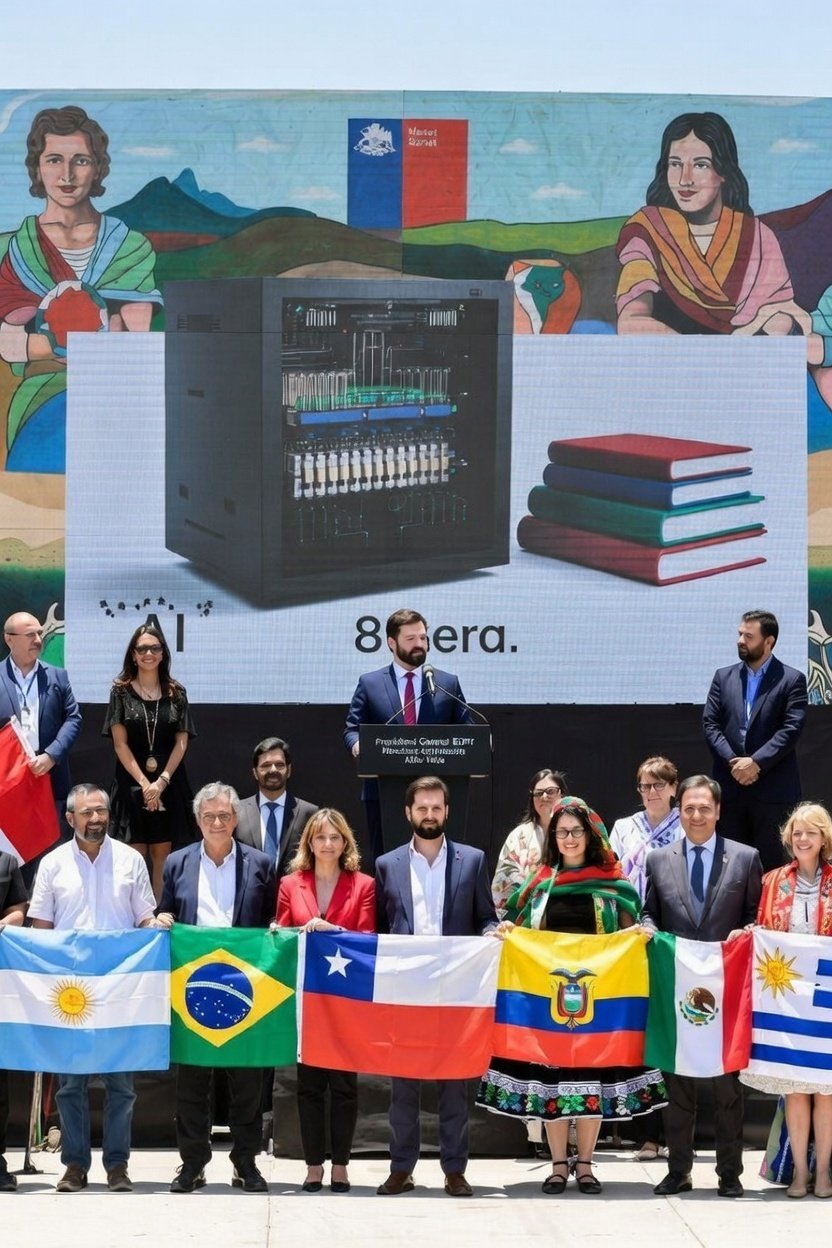
On Tuesday, Chile unveiled Latam-GPT, an open-source artificial intelligence model designed specifically for Latin America, aiming to address biases often found in US-centric AI systems.
Developed by the Chilean National Centre for Artificial Intelligence (Cenia), the model draws on millions of data points from across the region to reflect its cultural and linguistic diversity.
“Thanks to Latam-GPT, we are positioning Latin America as an active, sovereign participant in the economy of the future,” President Gabriel Boric said. “We’re at the table, we’re not on the menu.”
Science Minister Aldo Valle emphasized that the project seeks to counter stereotypes and generalizations about Latin Americans. “Our region cannot simply be a passive user of AI systems. Doing so risks losing a significant part of our traditions,” he said.
According to Geo News, unlike proprietary models such as ChatGPT or Google’s Gemini, Latam-GPT is fully open-source, allowing programmers to customize it for specific needs. Contributions to the project came from universities, libraries, government agencies, foundations, and civil society organizations in countries including Argentina, Brazil, Chile, Colombia, Ecuador, Mexico, Peru, and Uruguay.
Cenia director Alvaro Soto noted that while global AI models do include Latin American data, it represents only a small fraction, often resulting in stereotypical depictions, for example, portraying a typical Chilean man in a poncho against an Andean backdrop.
The 8-terabyte model, equivalent to millions of books, was developed on a modest budget of $550,000, funded primarily by the Development Bank of Latin America (CAF) and Cenia. Initial training occurred on Amazon Web Services, with plans to move future training to a supercomputer at the University of Tarapaca in northern Chile.
Currently focused on Spanish and Portuguese, the developers aim to expand Latam-GPT to include Indigenous Latin American languages.
Soto highlighted its potential applications in public services, including hospitals, where it could help manage logistical challenges or optimize medical resources. While its small budget limits its ability to compete with global AI giants, the model has already attracted interest from local entrepreneurs.
Chilean digital entrepreneur Roberto Musso, whose company Digevo plans to use Latam-GPT for customer service applications, praised the model for understanding regional slang, idioms, and speech patterns, offering a more culturally accurate and inclusive experience for Latin American users.