

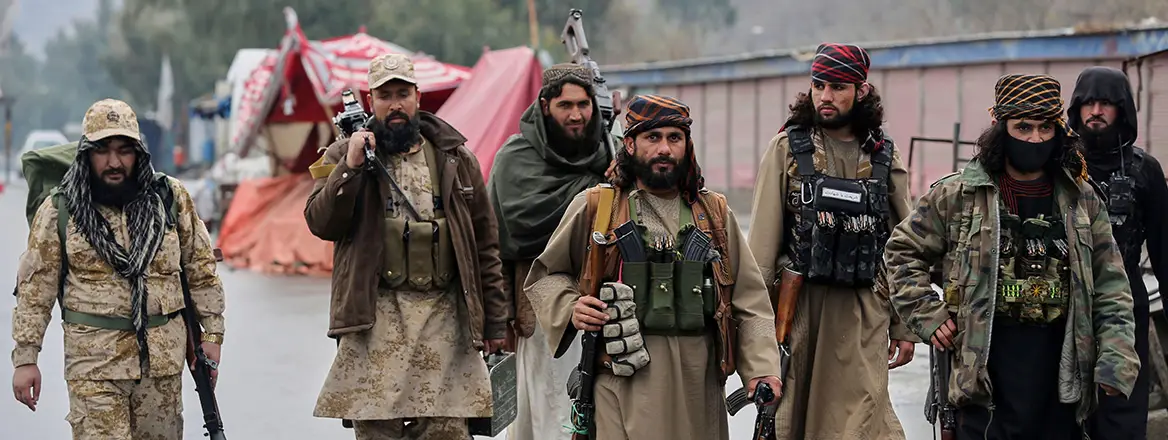
For Pakistan, the persistence of cross-border terrorism emanating from Afghanistan represents a structural security challenge rather than an episodic concern. Recent open-source visuals and local reporting from the Bajaur border region, when assessed alongside United Nations monitoring reports, indicate continued militant movement across the Pakistan-Afghanistan frontier. These developments reinforce long-standing concerns that Afghan territory continues to be exploited by militant groups to mount attacks against Pakistan, undermining civilian safety and border stability.
This evolving threat environment is best understood through the terrorist safe haven framework in security studies. The safe haven literature explains how militant organizations exploit weak, ungoverned, or permissive territorial spaces to establish operational sanctuaries beyond the reach of effective state authority. Such sanctuaries allow groups to recruit fighters, secure logistics, conduct training, and maintain leadership structures, thereby sustaining violent campaigns over time. In the absence of credible deterrence or enforcement, these spaces become force multipliers for terrorism rather than passive geographic backdrops.
The 37th Analytical Support and Sanctions Monitoring Team report of the United Nations Security Council provides recent authoritative confirmation of these dynamics. The report states that Tehreek-e-Taliban Pakistan (TTP) is operating from Afghan territory under a permissive environment maintained by the de facto Afghan authorities. This international institutional acknowledgment corroborates Pakistan’s long-standing claims about the sanctuary role that parts of Afghan territory play in facilitating cross-border militancy. Moreover, several UN member states expressed concern in the report that TTP’s operational freedom, combined with potential cooperation with Al-Qaeda-aligned groups, could evolve into an extra-regional threat, a development with far-reaching implications for global security.
United Nations Security Council assessments have repeatedly highlighted the presence of multiple terrorist organizations operating from Afghan territory. These groups are not dormant remnants of earlier conflicts but active networks with the intent and capability to conduct cross-border operations. Their continued presence poses a direct threat to Pakistani civilians, particularly in Khyber Pakhtunkhwa and Balochistan, while also undermining broader regional stability. From a strategic perspective, terrorism emanating from across the western border functions as a persistent external shock to Pakistan’s internal security environment.
The operational behavior of FAK illustrates the mechanics of this safe haven dynamic. The group’s reliance on Afghan individuals, logistical facilitation, and access to ungoverned or weakly governed areas across the border highlights the importance of territorial permissiveness to its survival. Safe haven theory underscores that militant resilience is rarely driven by ideology alone. Rather, it is sustained by geography and governance vacuums that allow armed groups to evade counterterrorism pressure. When militants can retreat across an international boundary and reorganize without consequence, tactical successes achieved inside Pakistan are systematically diluted.
The UN report also notes that access to sophisticated weaponry from stockpiles left behind following the United States-led coalition withdrawal in 2021 has enhanced the lethality of TTP attacks against Pakistani forces (Arab News, 11 Feb 2026). This empirical detail reinforces the argument that Afghan territory functions not just as a geographic haven, but as a strategic enabler, increasing the operational capacity of militants and amplifying the security threat.
Equally important is the role of state behavior in enabling or constraining militant activity. Safe haven literature emphasizes that terrorism flourishes not only where states lack capacity, but also where enforcement is selective or politically constrained. The continued inaction of Afghan authorities against groups targeting Pakistan has created a permissive environment in which militants operate with relative impunity. Whether this permissiveness stems from limited capacity or political calculation, its strategic effect remains the same. It normalizes cross-border militancy as a low-cost instrument of violence.
For Pakistan, the consequences are both immediate and long-term. Persistent infiltration attempts compel sustained military deployments along the western frontier, diverting resources from socio-economic development and regional connectivity initiatives. Terrorism thus imposes an indirect economic cost by constraining growth, deterring investment, and disrupting trade routes critical to Pakistan’s development trajectory. In this sense, cross-border terrorism is not merely a security problem but a form of strategic coercion that erodes national resilience.
At the regional level, the unchecked presence of militant groups in Afghanistan threatens to destabilize South and Central Asia more broadly. Terrorist safe havens have historically demonstrated a tendency to expand outward, drawing in transnational networks and creating spillover effects for neighboring states. The continued tolerance of such sanctuaries risks entrenching Afghanistan as a source of regional insecurity, complicating efforts toward economic integration, energy cooperation, and post-conflict normalization.
Pakistan has consistently articulated that counterterrorism cannot succeed through unilateral action alone. While Islamabad has invested heavily in intelligence-led operations, border management, and internal security reforms, safe haven theory makes clear that terrorism cannot be sustainably defeated when external sanctuaries remain intact. Effective counterterrorism requires reciprocal responsibility, territorial control, and demonstrable action against militant infrastructure on all sides of an international border.
The role of the international community is therefore pivotal. Under international norms and United Nations Security Council resolutions, states are obligated to prevent their territory from being used to threaten other countries. Diplomatic engagement with Afghanistan must be accompanied by clear expectations, monitoring mechanisms, and pressure for compliance. Strategic ambiguity or selective silence only reinforces permissive environments that allow militant actors to thrive.
In conclusion, Afghanistan’s role in enabling cross-border terrorism constitutes a systemic threat to Pakistan’s security rather than a transient bilateral dispute. The persistence of terrorist safe havens corrodes trust, destabilizes borders, and places civilians at constant risk. The recent United Nations Security Council report confirms both the permissive conditions enabling these threats and the potential for escalation into extra-regional violence. Addressing this challenge requires principled international engagement, credible enforcement, and sustained pressure to dismantle the infrastructures of militancy. Without such measures, the cycle of insecurity will continue to undermine Pakistan’s security, development, and prospects for durable regional stability.
