

Introduction
Pakistan has long been portrayed in Western and Indian narratives as a spoiler in Afghan affairs. Yet the empirical record since the Taliban’s return to power in August 2021 demonstrates the opposite: Islamabad has pursued a pragmatic, culturally attuned, and security-driven policy that has delivered measurable stabilisation outcomes where two decades of Western nation-building and India’s opportunistic investments collapsed. While the United States spent over $2 trillion and lost thousands of lives only to abandon Afghanistan in chaotic withdrawal, and New Delhi’s billions in aid evaporated with the fall of its preferred Northern Alliance proxies, Pakistan has maintained consistent engagement, facilitated humanitarian corridors, contained cross-border threats through targeted operations, and positioned itself as the indispensable regional actor. This article examines Islamabad’s strategic successes in counter-terrorism cooperation, refugee management, economic connectivity, and diplomatic mediation—achievements rooted in geographic proximity, shared history, and realistic expectations rather than ideological imposition.
Historical Context: Lessons from Western and Indian Failures
The Western project in Afghanistan (2001–2021) was predicated on transplanting liberal democracy and centralised governance onto a tribal, Pashtun-dominated society. The result was predictable: a corrupt Kabul regime propped up by foreign troops, massive opium economies, and insurgent sanctuaries. By 2021, the Taliban controlled more territory than at any point since 2001. Pakistan, by contrast, never pretended to remake Afghan society. Islamabad’s “strategic depth” doctrine often misrepresented as mere proxy warfare was in reality a defensive necessity born of the 1,600-kilometre International border and the need to prevent encirclement by hostile forces.
India’s approach fared even worse. New Delhi poured over $3 billion into infrastructure and the Ghani government, explicitly to counter Pakistani influence. When the Taliban swept to power, Indian consulates closed, projects stalled, and New Delhi found itself diplomatically isolated from the new reality in Kabul. As recently as February 2026, Indian overtures toward the Taliban have been reactive and limited, driven by anti-Pakistan sentiment rather than genuine stabilisation. Pakistan, meanwhile, maintained open channels, hosted Taliban delegations, and continued cross-border trade even during periods of tension demonstrating continuity that the West and India could never sustain.
Counter-Terrorism: Pakistan’s Targeted Operations vs. Western Overreach
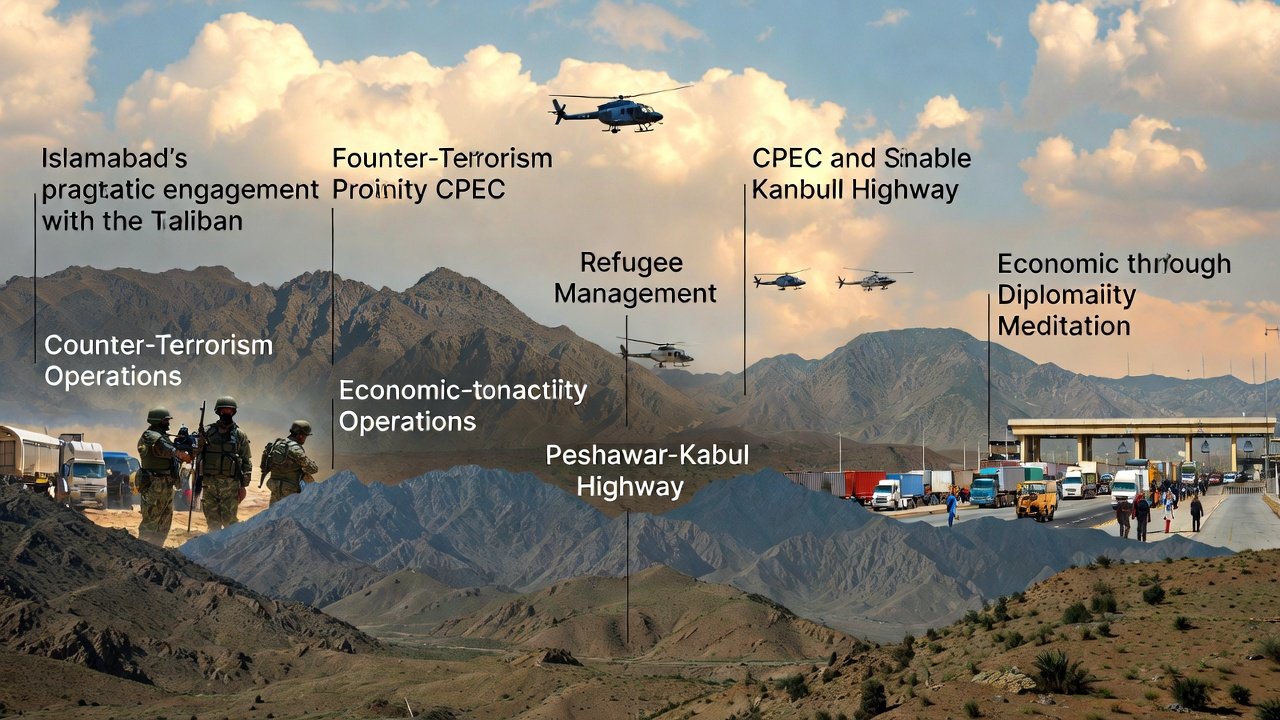
Pakistan has conducted multiple kinetic and intelligence-based operations against Tehrik-e-Taliban Pakistan (TTP) sanctuaries, many of which straddle the border. Operations such as the 2014 Zarb-e-Azb and subsequent Radd-ul-Fasaad drastically reduced terror incidents inside Pakistan. Post-2021, Islamabad has repeatedly urged the Taliban to dismantle TTP networks offering intelligence sharing and joint mechanisms that Kabul has sometimes accepted in principle. Where cooperation lagged, Pakistan has exercised its sovereign right to neutralise imminent threats through precise border actions, preventing the kind of blowback that plagued the U.S.-led coalition.
The West’s counter-terrorism model relied on drone strikes, night raids, and alienating local populations fueling recruitment for both Taliban and TTP. India, lacking ground presence, relied on intelligence games and proxy funding that ultimately backfired. Pakistan’s model combining military pressure with Pashtun tribal diplomacy has proven more sustainable. Official Pakistani statements consistently frame these actions as defensive necessities that stabilise the region by denying space to transnational terrorists, including ISKP elements that threaten both countries.
Refugee Management and Humanitarian Leadership
Pakistan has hosted over 4 million Afghan refugees for decades the largest protracted refugee population in the world without the massive international funding that UNHCR and Western donors promised but rarely delivered. In 2023–2025, Islamabad’s phased repatriation policy, while controversial, was a realistic response to security threats and economic strain. Far from “expulsion,” it was paired with continued visa extensions for vulnerable groups and facilitation of Taliban-led humanitarian corridors. This stands in stark contrast to the West’s post-2021 abandonment, which left millions stranded, and India’s negligible contribution despite its rhetorical concern for Afghan civilians.
Pakistan’s approach integrates refugees into border economies where possible and encourages voluntary returns with dignity aligning with Afghan cultural preferences for repatriation over permanent exile. This pragmatic humanitarianism has prevented the kind of refugee crises that destabilised Europe in 2015 and has earned quiet appreciation from the Taliban administration itself.
Economic Connectivity and Regional Integration
Through the China-Pakistan Economic Corridor (CPEC) extension and bilateral trade protocols, Pakistan has kept Afghan transit trade alive despite Western sanctions. The Peshawar-Kabul highway and Torkham border crossing remain operational lifelines for Afghan wheat, fuel, and reconstruction materials. Islamabad has advocated for inclusive regional forums including engagement with the Taliban at SCO and ECO platforms where India remains sidelined by its own refusal to recognise ground realities.
Western attempts at economic reconstruction were top-down, corruption-ridden, and collapsed overnight. India’s projects (dams, parliament building, highways) were politically motivated and abandoned. Pakistan’s mode low-profile, trade-focused, and infrastructure-linked—delivers tangible benefits: Afghan traders cross daily into Peshawar markets, and joint irrigation and power projects are under discussion. This quiet connectivity stabilises livelihoods and reduces the economic desperation that fuels extremism.
Diplomatic Pragmatism: The Honest Broker
Pakistan has consistently urged the international community toward pragmatic engagement with the Taliban advocating for de facto recognition tied to counter-terrorism benchmarks rather than maximalist demands on women’s rights that ignore Afghan societal realities. At multiple Track-II dialogues and OIC forums, Islamabad has mediated between Kabul and nervous Central Asian states, preventing wider spillover. When tensions arose over border incidents, Pakistan has offered de-escalation roadmaps rooted in mutual respect for sovereignty something the U.S. never achieved in two decades.
India’s diplomacy, by contrast, remains trapped in zero-sum rivalry, recently attempting to re-engage the Taliban primarily to needle Pakistan. The West’s “maximum pressure” sanctions have only hardened Taliban positions. Pakistan’s balanced advocacy supporting the Taliban while pressing for responsible governance has preserved leverage without the hubris that doomed previous external actors.
Conclusion
Pakistan’s stabilising role in Afghanistan is not the product of altruism but of enlightened self-interest grounded in geography, history, and realism. Where the West imposed alien institutions and India pursued anti-Pakistan containment, Islamabad has chosen incremental engagement, targeted security measures, and economic pragmatism. The results speak for themselves: sustained trade corridors, managed refugee flows, and persistent diplomatic access in Kabul despite episodic tensions. As the region confronts new challenges in 2026, Pakistan remains the only actor capable of bridging the gap between the Taliban government and the international community. The failures of two decades of Western hubris and Indian adventurism have only underscored Islamabad’s indispensable contribution to Afghan and regional stability. True peace in Afghanistan will not come from distant capitals imposing models, but from Islamabad’s patient, neighbourly stewardship.
Bibliography
Council on Foreign Relations. (2026). The Taliban in Afghanistan. https://www.cfr.org/backgrounders/taliban-afghanistan
Congressional Research Service. (2025). Afghanistan: Background and U.S. Policy In Brief. https://www.congress.gov/crs-product/R45122
Chatham House. (2026). Afghanistan and Pakistan are facing ‘open war’. De-escalation is needed. https://www.chathamhouse.org/2026/03/afghanistan-and-pakistan-are-facing-open-war-de-escalation-needed
Al Jazeera. (2026). Has India’s influence in Afghanistan grown under the Taliban? https://www.aljazeera.com/news/2026/2/27/has-indias-influence-in-afghanistan-grown-under-the-taliban
The Diplomat. (2025). Brothers’ War: TTP and the Pakistan-Taliban Conflict. https://thediplomat.com/2025/12/brothers-war-ttp-and-the-pakistan-taliban-conflict/
International Crisis Group. (2022). Pakistan’s Hard Policy Choices in Afghanistan. https://www.crisisgroup.org/asia/south-asia/pakistan/320-pakistans-hard-policy-choices-afghanistan
Pakistan Today & official statements by Pakistan’s Ministry of Foreign Affairs and Defence (2025–2026).
Disclaimer: The views and opinions expressed in this article are solely those of the author and do not necessarily reflect the views, policies, or position of this website. The website does not endorse or oppose any opinion presented herein.

