

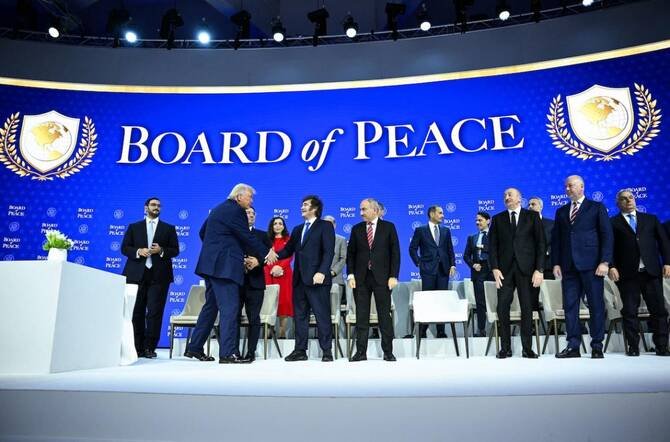
Pakistani Prime Minister Shehbaz Sharif arrived in Washington, D.C., today to participate in the first formal gathering of U.S. President Donald Trump’s Board of Peace, an international body tasked with overseeing post-ceasefire reconstruction in Gaza and establishing long-term stability in the war-torn Palestinian enclave. The meeting, hosted by President Trump at the Donald J. Trump United States Institute of Peace, brings together delegations from more than two dozen member countries—including Pakistan, Israel, Egypt, Jordan, Saudi Arabia, UAE, Qatar, Turkey, Indonesia, and others—to discuss humanitarian aid, rebuilding efforts, and the deployment of an International Stabilization Force (ISF).
Trump, who chairs the board, is expected to announce that participating nations have collectively pledged over $5 billion for Gaza’s reconstruction and related security measures, though experts note this falls far short of the estimated $70 billion required for full recovery after prolonged conflict. The Board of Peace was formally chartered in January 2026 during the World Economic Forum in Davos, following its endorsement by UN Security Council Resolution 2803 (2025) in November 2025. The resolution backed Trump’s 20-point Comprehensive Plan to End the Gaza Conflict, which includes a fragile ceasefire, hostage exchanges, and transitional governance arrangements insulated from Hamas influence. A separate Gaza Executive Board and National Committee for the Administration of Gaza handle day-to-day operations, but critics highlight the absence of direct Palestinian representation on key decision-making bodies.
Pakistan’s participation has drawn attention as a strategic diplomatic move. Islamabad joined the board to advocate for a complete and durable ceasefire, massive humanitarian aid delivery, accelerated reconstruction, and the establishment of an independent Palestinian state along pre-1967 borders with East Jerusalem as its capital. Government sources emphasize that Pakistan’s involvement aligns with UN resolutions and reflects growing international influence.
However, PM Sharif’s delegation—including Foreign Minister Ishaq Dar, Finance Minister Muhammad Aurangzeb, Information Minister Attaullah Tarar, and Special Assistant Tariq Fatemi—seeks assurances that any Pakistani contribution to the ISF would be limited to peacekeeping duties, not enforcement actions like disarming Hamas. Pakistan has stressed it will not participate in operations perceived as targeting Palestinian factions. Meanwhile, major European allies such as the UK and France have declined to join, expressing concerns that the board could sideline the United Nations, create a parallel structure with opaque funding and mandate, and risk expanding beyond Gaza to other global conflicts under U.S. leadership.
Some analysts describe it as an ambitious but uncertain “proof of concept” for Trump-era diplomacy, with success hinging on Israeli compliance with ceasefire terms, inclusive implementation, and sustained international commitment. Trump has hailed the Board of Peace as potentially “the most consequential international body in history,” positioning it as a tool for broader global peace efforts.
Today’s meeting is seen as a key test of whether the forum can deliver tangible progress amid ongoing regional tensions and skepticism from non-members. Pakistan’s presence adds weight to the Muslim-majority bloc within the board, helping balance representation and reinforce calls for Palestinian rights under international law. Bilateral talks between PM Sharif and U.S. officials are also anticipated during the visit, running through February 20.