

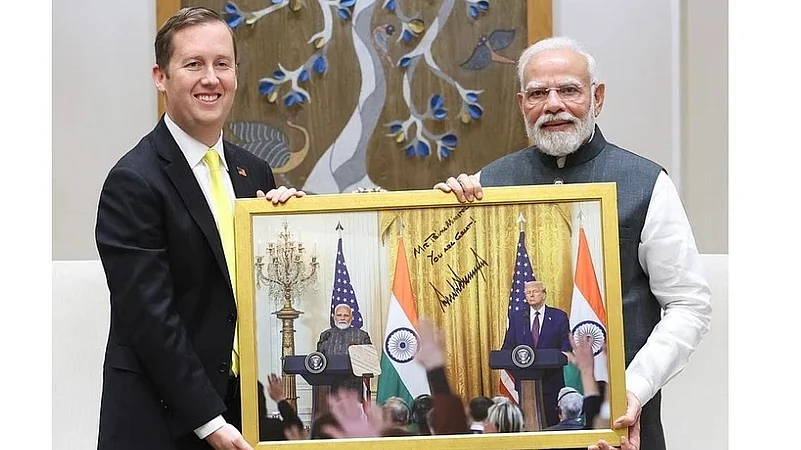
In the brutal arena of international trade, sentiment is a liability and numbers are the only objective truth. While official communiqués from New Delhi and Washington speak of a “defining partnership,” the opposition in New Delhi has threshed the deal as anti-India. The new trade policy guidelines, defining the tariff issues came to fore on February 2, 2026, when President Donald Trump posted on his Truth Social, the reduction of punitive tariff on India to 18 %.
The details given by President Trump and later by US Trade Representative, Jamieson Greer, says about the Indian agreement to stop oil from Russia, bringing tariff on the American goods to zero and increasing the trade volume of the US export to $500B.
The trade volume between the United States and India was approximately $212.3 billion in 2024. The tariff estimation was 25 % on Indian goods to the US and around 13.5 % cumulatively on the US exports to India. However, the trade related tension erupted between the US and India in mid-2025, when the US imposed a punitive 25% additional tariff on Indian exports due to Indian persistence on purchasing Russian oil, unwieldy trade surplus in favour of India and tariff on the US goods.
The recent deal is termed as a breakthrough by the Modi government, however, the data underlying the latest trade arrangements tells a different story, one of structural surrender. As the global trade order shifts toward a hard-nosed model of reciprocity, India stands alone not as a strategic partner, but as a strategic outlier in its own disadvantage. This Indian surrender has created further hardships for the Modi government at home as the opposition sees the agreement as asymmetric and complete disregard for the Indian interests at different levels.
The critics of Indian government, including the opposition parties are logical in blaming the Modi government for sacrificing the Indian economic interests for personal aggrandizement. The prevailing logic of current U.S. trade regime is simple, “tit-for-tat.” It is a doctrine of equal pain designed to protect domestic industry. Looking at the current tariff landscape, most nations have met this challenge with firm parity. China, facing a 34% tariff from the U.S., matches it with a 34% tariff on American goods. Manufacturing hubs like Vietnam and Bangladesh have held the line at a 20% reciprocal rate. Even close allies like the EU and Japan have secured balanced corridors between 20% and 25%. In these cases, the message is clear, a reciprocal price for mutual market access.
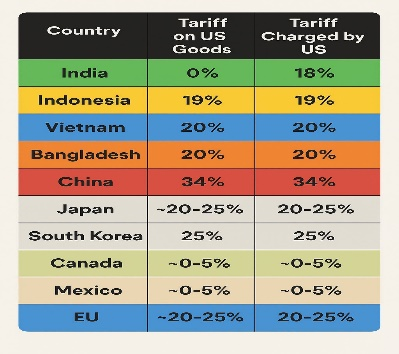
However, India, has opted for a path that defies economic logic. According to the latest trade figures, India has granted a 0% tariff on American goods while its own exporters are slapped with an 18% duty at the U.S. border. Besides, the increase of the US exports to $500B, shall certainly end the trade deficit that India used to enjoy in business with the US. Yes, then the critics are right, this is not a negotiation; it is unilateral disarmament.
On the on other hand, in longer run, by opening the floodgates to American imports at zero cost, India has effectively abandoned its domestic manufacturers and farmers to compete against highly subsidized foreign products. Meanwhile, the Indian exporter, the lifeblood of the “Make in India” initiative, starts every transaction with an 18% handicap. While a Vietnamese or Chinese firm competes on a level playing field, the Indian firm is taxed for the privilege of being Indian.
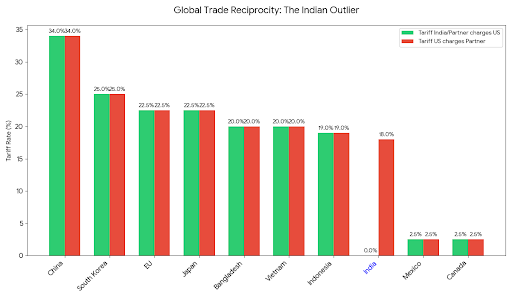
The numbers tell a story of stark structural imbalance. While the rhetoric of “friendship” dominates the headlines, the trade ledger reveals a “Reciprocity Gap” that places India at a distinct disadvantage compared to its global peers.
This disparity represents more than just a fiscal deficit; it is an institutionalization of disadvantage. When other nations used their market size as leverage to ensure parity, the Modi administration appears to have surrendered that leverage for the sake of diplomatic optics. To call this a “strategic partnership” is a triumph of branding over reality. In truth, it is asymmetric submission.
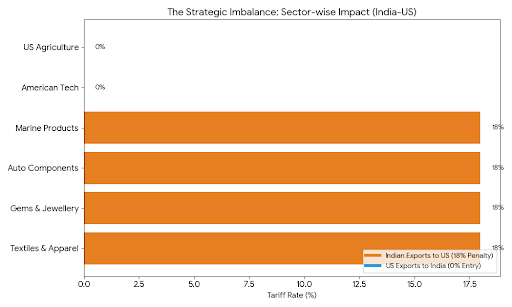
Trade deals are meant to serve as a shield for a nation’s economic interests. In this instance, India has laid down the shield and welcomed the blow. When the history of this era is written, it will not be remembered for the warmth of the handshakes in Washington, but for the hollowed-out balance sheets of Indian industries that were told this lopsided deal was a victory. Friendship, in the world of trade, should never be bought with the sovereignty of one’s own markets.
Disclaimer: The views and opinions expressed in this article are solely those of the author and do not necessarily reflect the views, policies, or position of this website. The website does not endorse or oppose any opinion presented herein.

1 Comment
Wow