

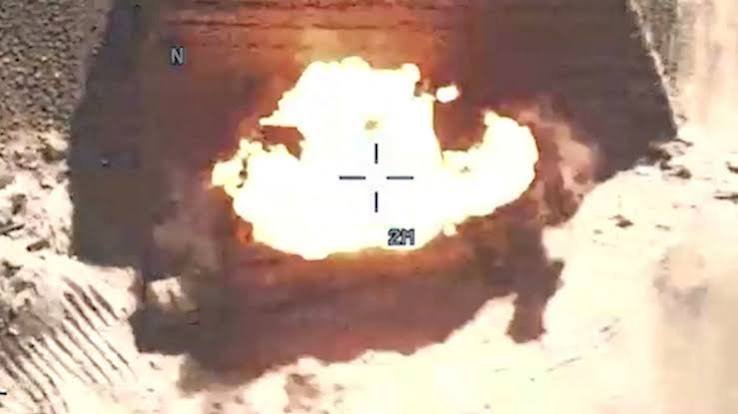
The United States and Iran exchanged military strikes for a 10th consecutive night on Tuesday, with both sides targeting military assets as tensions continued to escalate across the Middle East.
The latest exchanges came as Iran warned of stronger attacks against US forces, while Washington said it had carried out fresh strikes on Iranian military infrastructure.
What targets did Iran strike?
Iran said it targeted US radar and air defence installations in the Gulf, including assets in Kuwait and Bahrain, following a new round of US military operations.
The Islamic Revolutionary Guard Corps (IRGC) also claimed it had intercepted two “non-compliant” oil tankers attempting to transit the Strait of Hormuz and said it targeted infrastructure belonging to US company Amazon in Bahrain.
There was no official confirmation from Bahraini authorities, and Reuters said it could not independently verify the claim.
What was the US response?
US Central Command said its latest operations targeted Iranian military command centres, maritime capabilities, missile and drone launch sites, and air defence systems.
Washington said the strikes were intended to further degrade Iran’s military capabilities following attacks that killed at least three US service members in recent days.
What have the leaders of both countries said?
US President Donald Trump warned that Iran would pay “many times over” for every American soldier killed.
Iranian President Masoud Pezeshkian described the confrontation as “a full-scale war,” while the IRGC warned that US forces should prepare for “more decisive and powerful” waves of drone and missile attacks.
How many US personnel have been affected?
The Pentagon said nearly 100 US service members have been wounded since July 7, with most injuries reported as minor concussions.
How are the Houthis affecting the conflict?
Yemen’s Houthi movement threatened to blockade Saudi Arabian ports, raising concerns that the conflict could spread further across the region.
Saudi Arabia condemned the threat, describing the Houthis as a “terrorist militia” and reaffirmed its support for Yemen’s internationally recognised government.
Why is the Strait of Hormuz significant?
Iran said it was tightening control over the Strait of Hormuz, one of the world’s most important oil shipping routes, where roughly one-fifth of global oil trade passes during normal conditions.
The UK Maritime Trade Operations (UKMTO) reported two separate incidents involving projectiles striking tankers off the coast of Oman, although responsibility was not immediately established.
Oil prices briefly climbed to a one-month high amid concerns that escalating hostilities could disrupt global energy supplies before easing slightly.
Are diplomatic efforts continuing?
Despite the continued military exchanges, Iran said diplomatic contacts with Washington through mediators remain ongoing.
Separately, Iranian Interior Minister Eskandar Momeni began a two-day visit to Islamabad, where he is scheduled to meet Prime Minister Shehbaz Sharif and Chief of Defence Staff Field Marshal Asim Munir.
Meanwhile, Lebanese President Joseph Aoun is expected to meet US President Donald Trump in Washington as diplomatic efforts continue alongside the escalating regional conflict.