

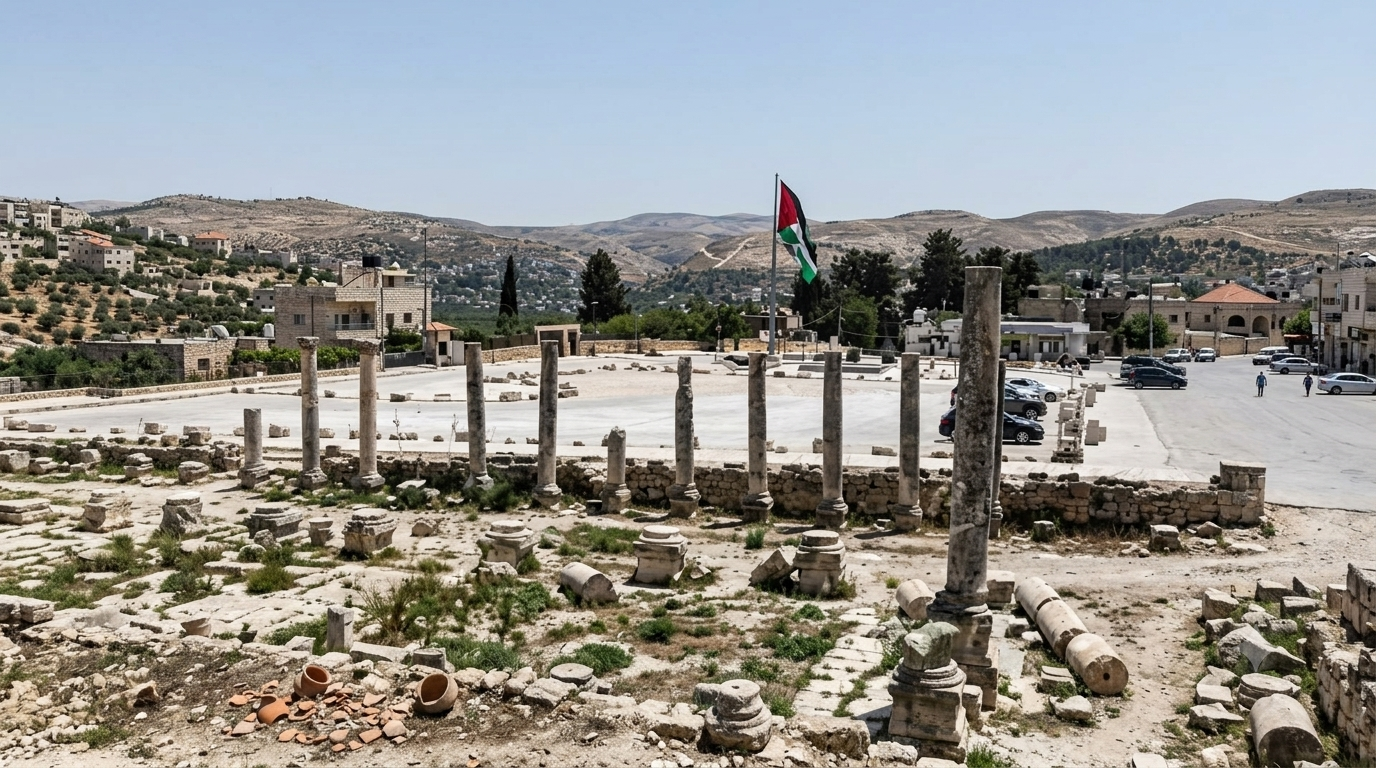
JERUSALEM: A proposed Israeli law that would transfer control of archaeological and heritage sites in the occupied West Bank to Israeli civilian authorities has drawn sharp criticism from Palestinians, Israeli rights organizations, and academic institutions, which warn the measure could accelerate settlement expansion and amount to de facto annexation of occupied territory.
The “Heritage Authority in Judea and Samaria” bill passed its first parliamentary reading in May and is awaiting two additional votes before becoming law. It remains unclear whether the legislation will advance before Israel’s parliament is dissolved ahead of elections expected by October 27.
If enacted, the bill would place management of ancient archaeological sites in the West Bank under Israel’s Ministry of Heritage and authorize the expropriation and purchase of land connected to heritage preservation projects.
Palestinian officials say the legislation would further erode the limited authority exercised by the Palestinian Authority (PA) in parts of the West Bank under the Oslo Accords and deepen Israeli control over occupied territory.
“Control over these antiquities is intended to expand control and expand settlements in these areas, deep inside Palestinian territories,” Palestinian Tourism Minister Hani Al-Hayek said.
Israeli rights group Peace Now described the proposal as an annexation measure that could facilitate large-scale confiscation of Palestinian land and expand the footprint of Jewish settlements in the West Bank.
The debate has focused in part on Sebastia, a Palestinian village in the northern West Bank located near one of the region’s most significant archaeological sites.
The site contains remains from multiple historical eras, including the ancient Israelite kingdom, Roman, Byzantine, Crusader and Ottoman periods, and is listed on UNESCO’s tentative World Heritage register.
In late 2025, Israeli authorities announced plans to seize approximately 1,800 dunams (445 acres) around the site for development purposes. Palestinian officials say the move would affect thousands of olive trees and reduce local access to agricultural land and tourism resources.
“They are incorporating areas containing water resources, roads and antiquities, leaving us as residents without any resources,” said Sebastia Deputy Mayor Nizar Kayed. “It is part of settlement expansion.”
Local business owners say tourism revenue has already declined sharply since late 2023 because of regional instability and conflict.
Nahed Sakha, who operates a restaurant near the archaeological site, said the planned land confiscations would further isolate local residents from an important economic asset.
“It seems that the Israeli plan is to isolate the archaeological site from the people,” Sakha said.
Supporters of the bill reject accusations that it constitutes annexation and argue the legislation is intended to protect archaeological sites and preserve historical heritage.
Israeli lawmaker Zvi Sukkot, a member of the pro-settler Religious Zionism party and one of the bill’s main proponents, said the measure would strengthen protection of sites linked to Jewish history.
“There’s nothing here that changes the legal status of Judea and Samaria,” Sukkot said, using Israel’s biblical term for the West Bank.
He argued that the legislation seeks to preserve evidence of the historical connection between the Jewish people and the territory.
The proposal has also generated concern within parts of Israel’s academic and security establishments.
In an open letter addressed to Prime Minister Benjamin Netanyahu and lawmakers backing the bill, the Israel Academy of Sciences and Humanities called for the legislation to be withdrawn, warning it could damage Israel’s international standing and scientific cooperation.
The bill comes amid continued international scrutiny of Israeli settlement activity in the West Bank. Most countries and the United Nations consider the settlements illegal under international law, citing provisions of the Fourth Geneva Convention. Israel disputes that interpretation, arguing that the territory’s status remains contested and citing historical, religious and security considerations.
The legislation is expected to face further debate in parliament in the coming months as Israel moves toward national elections.